Friday, 14 May 2010

Lightning conductors

One of the great things about being a bell ringer is that I get to up the church tower. You get the best view of Wigton from the top. Notice the thick metal strip running down from the spike at the top. It's a lightning conductor. It goes all the way down the outside of the tower and is then concreted into the ground. The idea is twofold:
1. If lightning does strike, the massive current is carried down the metal, which has a much lower resistance than the masonry. This stops the masonry overheating and the mortar being broken.
2. It actually deters lightning. If the cloud has a large positive charge, it attracts electrons, which are negative, up from the ground to the tip of the spike. The large concentrated charge ionises the air molecules and then repels negative ions up to the positive charge. This neutralises some of the charge, making lightning less likely.




Thursday, 6 May 2010

Basalt dykes


This photograph is of an igneous dyke on Anglesey. Molten magma must have forced its way sideways between existing layers and then solidified. The way that molten magma moves under the surface of the Earth is very much to do with physics. It is due to convection cycles in the mantle. I was interested to note that in Brian Cox's series on the Solar System, he attributed the loss of atmosphere on Mars to the cooling and solidifying of its molten core.

Wednesday, 21 April 2010

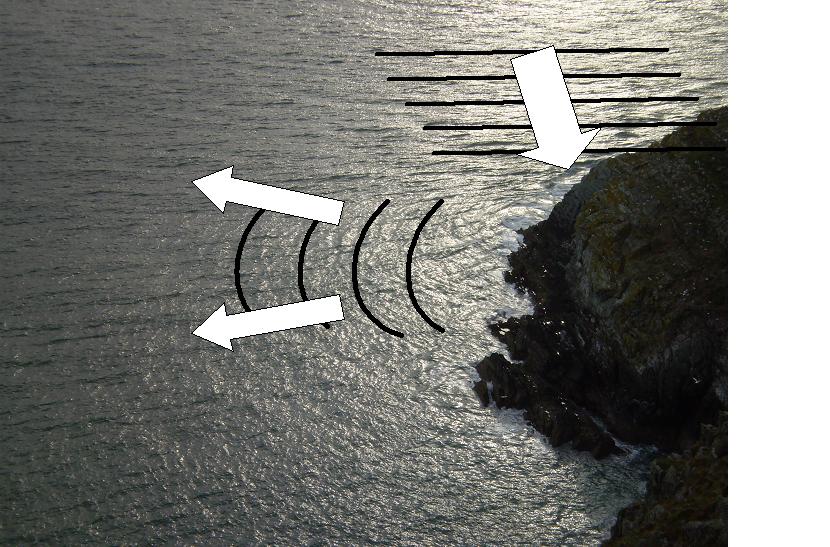
Wavefronts on Anglesey

Looking out over the sea from South Stack near Holyhead on Anglesey, I was able to see waves being reflected. Looking down, you see the ripple pattern of the peaks of the waves. This is called the wave front. I have drawn them on in black in case you can't pick them out. Huygens favoured the wave front analysis. Isaac Newton prefered to draw rays which show the direction of motion. You can't see motion in a still photograph so I've had to draw them in for you as arrows. Now you can see that plane waves (flat ones) are coming down from the top of the object and reflecting from a circular promontary. If plane waves reflect from a curved object, the reflected wave fronts are curved too.

Tuesday, 20 April 2010

Wrong again!

The blue sky is definitely polarised but not because of the ash cloud. The blue colour is caused by scattering. You can look at the post about this on this blog last September. The scattering process polarises light. That explains a thing that I noticed - the polarised light was in every direction excpet that close to the Sun. Light close to the Sun is less scattered.
Also, I was surprised by how quickly Mercury disappeared. I was confidently telling a group on Friday night that it was just behind a cloud, but it clearly wasn't. It must have moved a long way across the sky in a week and have changed to a position that is below the horizon. Mercury was the speedy messenger of the gods in mythology. That's why the fast planet got its name. Now I have seen it for myself.

Friday, 16 April 2010

Ash cloud and polarised sunlight

I heard a suggestion that the ash cloud from the Icelandic volcano might polarise sunlight. Ordinarily, light waves from the sun are unpolarised. This means that some vibrate up and down, some vibrate side to side and others vibrate diagonally. If the ash cloud polarises the light, it would mean that it would vibrate in one direction only. You can check this with a polarising filter. Point it at the sky and rotate it. If it goes alternately light, dark, light, dark every quarter of a turn then the light is polarised. I've just been out to try it and this has turned out to be the case. Of course, I need to try again when the ash cloud has gone to be fair. You could try it if your sunglasses are polarising - some are and others are just thick filters.

Tuesday, 13 April 2010

Planets in the night sky

I watched The Sky At Night on BBC4 last week. It's almost the longest running programme on TV and is, shall we say, a bit dry. However, they explained where to look for 4 planets that are visible before 10pm at the moment. I went looking. At 9pm, look in the direction of the sunset. There is a really bright star. That's actually the panet Venus. Down and right of it, maybe about the width of your hand held at arm's length, there is a much fainter dot. That is the planet Mercury. I'd never seen Mercury before. Last night I picked it out from the car park in the middle of Wigton. Mercury is closest to the Sun so it is only visible in the half light at sunset (and just before sunrise at other times). This makes it hard to see because it is not very bright. It is also close to the horizon as well and it has gone before it is properly dark. All this makes it hard to see. So I photographed Venus. It is clearly a disk and not a point. That makes it a planet. My next ambition is to see Venus go through phases like the Moon (Eg full disk, half disk, quarter disk etc) Galileo observed this. My telesope is really for wildlife not stars, but last night I picked out the rings of Saturn with the 40x lens. Life doesn't get much better than that! By the way, Saturn is roughly South West at 10pm and about 30 degrees up. Mars is almost above your head and clearly redder. You have a day to watch the second of the two programmes which tells you where to see the planets if you whizz through to nearer the end. http://www.bbc.co.uk/programmes/b006mk7h

Monday, 12 April 2010

Double rainbows

We had a very wet holiday on Anglesey over Easter but I did manage to catch up with a double rainbow. I read about these years ago but pulled up short a year or so ago when I finally noticed that the colours are reversed on the outer rainbow. Enlarge this picture and take a good look at it.
The colours of a rainbow are caused by total internal reflection of the light in a raindrop and the subsequent refraction as it leaves the front of the drop. For a double rainbow, the light reflects twice on the inside before exiting.
See http://en.wikipedia.org/wiki/Rainbow