We went to St Bees Head on Friday night. As you can see, the weather was beautiful. The lighthouse reminded me of the work I've been doing on pulsars with the Upper Sixth.
Pulsars are neutron stars that spin very fast. They have beams of electromagnetic radiation firing out of their magnetic poles, each one like the beam of light from a lighthouse. If that beam crosses the path of the Earth, then the effect is the same as the flash of a lighthouse seen from out at sea. We detect a regular pulse of radiation, hence the name "pulsar". They were so regular that when first discovered they were thought to be alien signals. The story of their discovery and the controversy over the Nobel Prize that wasn't awarded to Jocelyn Bell Burnell. It's a story you should read. Her humility has impressed me when I've seen her interviewed.
Neutron stars are formed when a huge star runs out of fuel. Whilst they still have hydrogen, stars are able to do nuclear fusion in their cores. This sends out a stream of photons of light, creating a radiation pressure to counteract gravitational collapse. At the end of their lives, the lack of radiation pressure leads to collapse. In small stars like the Sun, the fact that you can only have a certain number of electrons on each energy level stops collapse.
This is called electron degeneracy pressure (look up Pauli's Exclusion Principle for the proper theory). In huge stars, even this can't withstand the collapse so the electrons are crushed into the nucleus. They join with protons, which cancels the positive charge on the proton to form a neutron. There's your neutron star - just made of neutrons, not atoms.
The strong magnetic field comes from the original star, though it is strengthened as the star gets smaller and the field lines are pulled in. One perceptive student noted that charged particles are needed for magnetic fields and that neutrons are not charged. I had to look that up - apparently there are still some unattached protons and electrons in the star.
Wednesday, 8 May 2013
A quarter peal on the bells
We rang a quarter peal on Wigton's bells on Sunday night. For the uninitiated, that means ringing non-stop for about 45 minutes whilst changing the order in which the bells sound every time you pull. Congratulations to our youngest ringer for achieving a first quarter peal.
It got me thinking about the physics behind the bells. Here's a picture of the bells that I took at Easter.
You'll notice that the bells are upside down. This is necessary because it allows us to control quite precisely when the bell sounds. It also makes the bells unstable. This is because it raises the centre of gravity whilst reducing the area at the bottom. My GCSE classes know that when the line of action downwards from the centre of gravity falls outside the base area, an object will fall.
You'll also notice that bells are designed to move in circles. In Physics, we say that the bell will have angular momentum. Now, linear momentum is a measure of how difficult it is to stop an object that is moving in a line. Linear momentum is calculated by inertial mass x speed. Angular momentum is how hard it is to stop something moving in a circle. Angular momentum = moment of inertia x angular speed. Moment of inertia is roughly a combination of how heavy and how far from the centre of turning. Think of ice skaters. They spin slowly with arms outstretched because they have mass further from their body. They have a large moment of inertia at this point. As they bring their arms in, they spin faster - in other words, a lower moment of inertia means that they have a higher angular speed. This is because they conserve angular momentum.
When I pull a bell, it swings in a circle until I stop the bell by holding the rope. The problem is that I can't stop the clapper, which still has angular momentum. It carries on until it hits the bell and stops.
I also thought you might like to see the view of Wigton from the top of the bell tower!
Friday, 3 May 2013
Liquid Nitrogen is Cool
We went to Penrith yesterday for an evening on Low Temperature Physics. We learned about how they get very close to absolute zero at Lancaster University. And then we got to see the liquid nitrogen demonstrations! In this first picture, there is a piece of dark coloured ceramic superconductor at the bottom in a bath of liquid nitrogen. There is a small magnet levitating over it. This is the Meissner Effect, where the superconductor expels the magnetic field. I need to do more research on this. It may be part of a later blog post.
Phil has been trying to make a maglev track. There is a clear Perspex track with magnets in it. Then he uses two ceramic superconductors in a bit of polystyrene cup, which is there to take the liquid nitrogen.
Now the superconductors are levitating above the magnet track.
And they still hang on when it is flipped upside down!
When I was in the Sixth Form, it was compulsory for someone to put a tie in liquid nitrogen and then snap it in half. I brought one from the minging tie cupboard. Trouble is that it absorbed too much liquid nitrogen and wouldn't freeze. Oh well.
The rest of the liquid nitrogen was tipped out in the grounds...cool!
Big thanks to Chris and Phil from Lancaster University for the talk and demos, and also to QEGS for hosting!
Tuesday, 30 April 2013
Green Fluorescent Protein
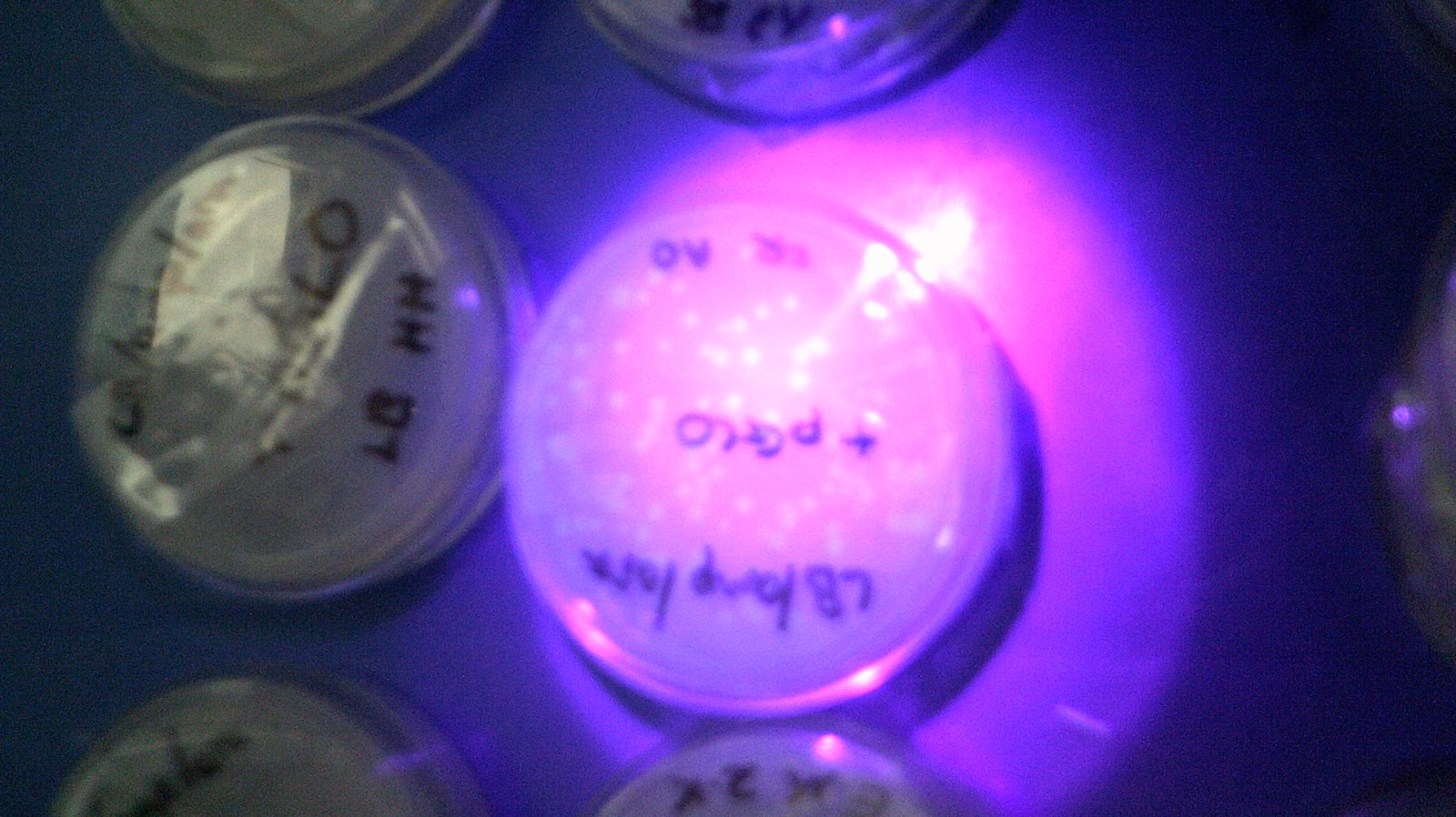
One of my friends had her class do some genetic engineering on bacteria. They used small loops of DNA called plasmids to insert genes from jellyfish into the bacteria. The genes let the bacteria make a protein that absorbs ultraviolet light and re-emit a greenish light. The bacteria were grown in agar plates. Here is a photograph of some of them taken in ultraviolet light.
The physics of this trick with light is explained like this:
1. Remember that elecrons are found on different energy levels in an atom. This is the "electron orbits" model that is used in GCSE Chemistry.
2. In A Level Physics, we cut out a section of the energy levels and concentrate on that.
3. Here are the cut out energy levels. What happens now is that a photon of ultraviolet light comes in from the left. This high energy light provides energy to make the electron go up several levels. The electron could fall back all the way in one go and release a similar ultraviolet photon, or it could fall down the levels in stages as shown. These smaller falls release smaller amounts of energy, so the photons have a lower frequency. The main jump down releases these lower frequency green photons, so that's what we see. In other words, the electron arrangements in the Green Fluorescent Protein are such as to absorb invisible ultraviolet photons and mainly release visible green photons.
The other clever thing is that the Green Fluorescent Protein gene is bundled with genes that give the bacteria resistance to the antibiotic called ampicillin. There is also a gene that means that the Green Fluorescent Protein gene only works in the presence of a sugar called arabinose. So the photograph at the top is for a plate treated with ampicillin and arabinose.
Tuesday, 16 April 2013
Catamarans at Ravenglass
We spotted two catamarans in the harbour at Ravenglass. I don't know a lot about sailing but I do use these boats as an example of stability. The double hull increases the base area. A boat will capsize when the line of its weight acting vertically downwards goes down beyond the edge of the base area. The wider the base area, the harder it is for this to happen. We talk about there being a resultant moment - an overall turning force - acting. If the boat tips, so long as the weight continues to act within the base area, this resultant moment will pull the boat back to its original position. Single hull boats have a keel under the water to produce a moment that opposes the turning force of the wind acting on the sail. I did look on Wikipedia and found that the lack of keel on the catamarans means that there is less drag from the water. Catamarans can go faster. They are not likely to tip over sideways, for the reasons given above, but a very strong wind can tip them over forwards - they sort of go head-over-heels.
Wednesday, 10 April 2013
DIY sundial at Seascale
Seascale is a town with some Physics pedigree - you can see the Sellafield plant looming large behind it in the picture below. I did once hear that it had the highest average IQ of any town in the country in the 1950s due to the influx of Physicists sent to build the plant. I wonder if that's still true.
So I was really pleased to find a lovely bit of Physics near the station. It's a sundial where you act as the gnomon and your shadow points to the correct time. There are even two sets of numbers - one set for GMT and the other for British Summer Time. The clever bit is the block you stand on - different months mean different shadow positions. Note that the months near the solstice have thinner sections. Those near the equinox have wider sections because the day length changes fastest near the equinox. It claimed to be to within 15 mins, but I thought it was 30 minutes out. Whatever - any equipment that even tries to state its uncertainty gets my vote!
Random bloke tries out the sundial.
The all important month block.
Saturday, 6 April 2013
Diffuse sky radiation
Thinking further after yesterday's post, the obvious thought struck me - there's still light on a cloudy day. The evidence is in the picture above. (We rang the bells in the Town Hall tower!) I remembered that this is due to SCATTERING. I didn't study this in my Engineering degree but have just learned a lot by Googling it. Clouds are an example of Mie Scattering - the water droplets are large compared to the wavelengths of light so all wavelengths have an equal chance of being scattered. This mix of all wavelengths gives clouds their white colour. However, the gas molecules in the air are much smaller than the wavelength of light, so they cause Rayleigh Scattering. Here the smaller the wavelength, the more the scattering. Blue has a small wavelength and so is scattered a lot by the air molecules, hence the sky looks blue. The scattered light reaching us on the surface of the Earth is then called diffuse sky radiation. So it started in one place - the Sun - but the light was then scattered and appears to be coming down from all over the sky.
This was the view of Berwick from our pitch on the caravan park. It looks like a medieval Italian town with the red roofs and its Elizebethan walls. Note the blue sky! But it takes me back to Dan's big question last month: "Violet has a shorter wavelength than blue, so it must be scattered more. Why isn't the sky violet?" Google revealed that the answer is that it might be but that the physiology of your eye means that the cone cells detect blue wavelenghts far better than violet.
Subscribe to:
Posts (Atom)