Saturday, 3 August 2013

Inside the Diamond

Last December I went on a tour of the Diamond synchrotron. Here's a photograph of the model inside. The smaller circle on the left hand side is where they accelerate the electrons up to speed before sending them around the main circle.
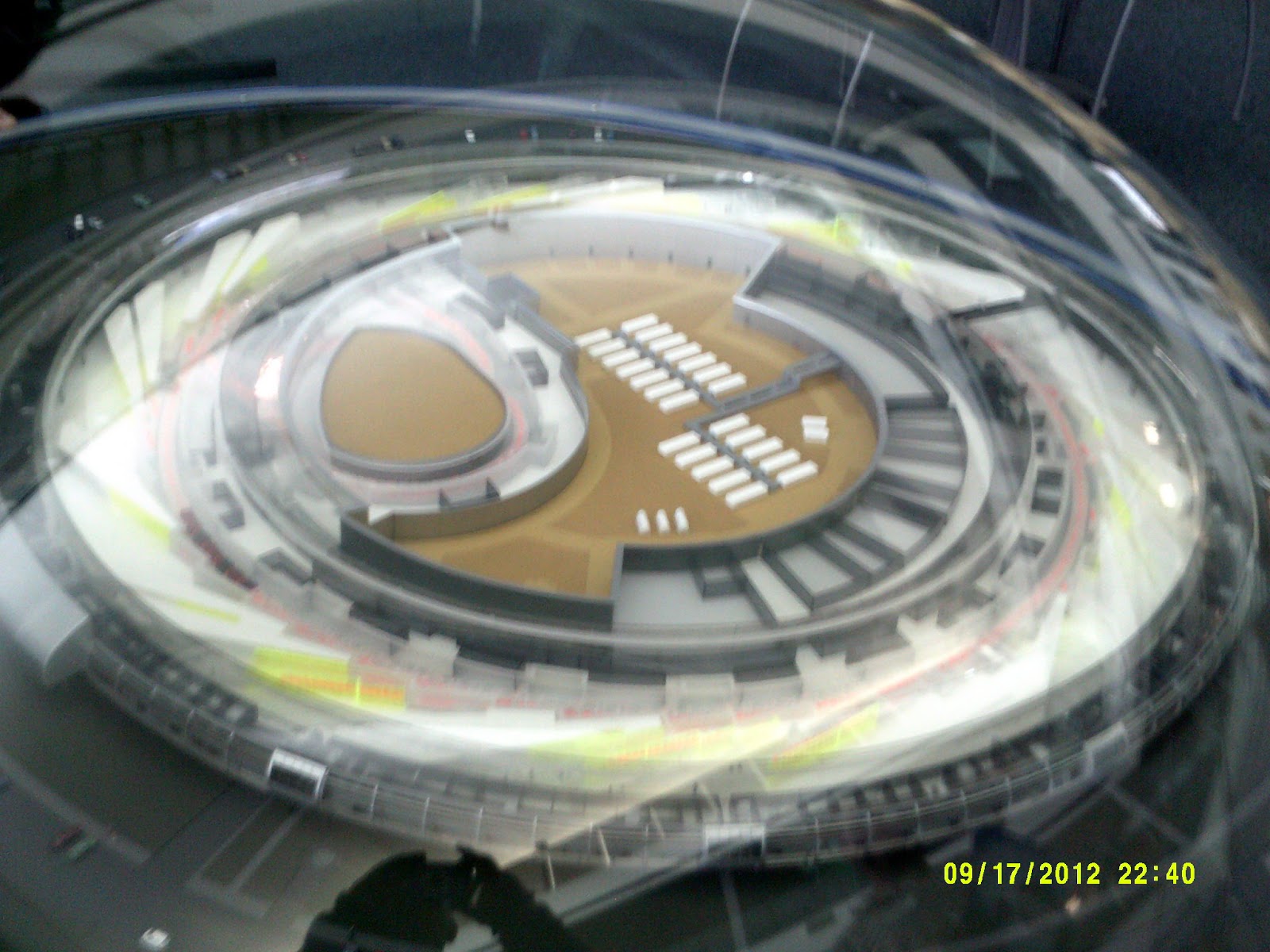
 
This photograph is taken inside the facility, stood on top of the main circle.

 
The electrons don't in fact go round in a perfect circle. They go along a series of straights and are then bent at corners. The yellow line on the floor shows the path of the beam.
 
 
The sort of magnet arrays that bend the beam are shown in the model photographed below. To change the motion of the electron beam in this way means that a beam of high energy electromagnetic radiation is released. This comes out as high energy X-rays, which carry on in a straight line when the electron beam (yellow line) changes direction.
 
 
The X-rays go straight on into facilities called huts. Experiments are set up in the huts. The X-rays go through samples to show, for example, the structure of a protein.

 
Diamond has a brilliant website. Here's a link to the education bit http://www.diamond.ac.uk/Home/Teachers.html . There are open days. Their staff were brilliant!


Friday, 2 August 2013

Ancient and modern

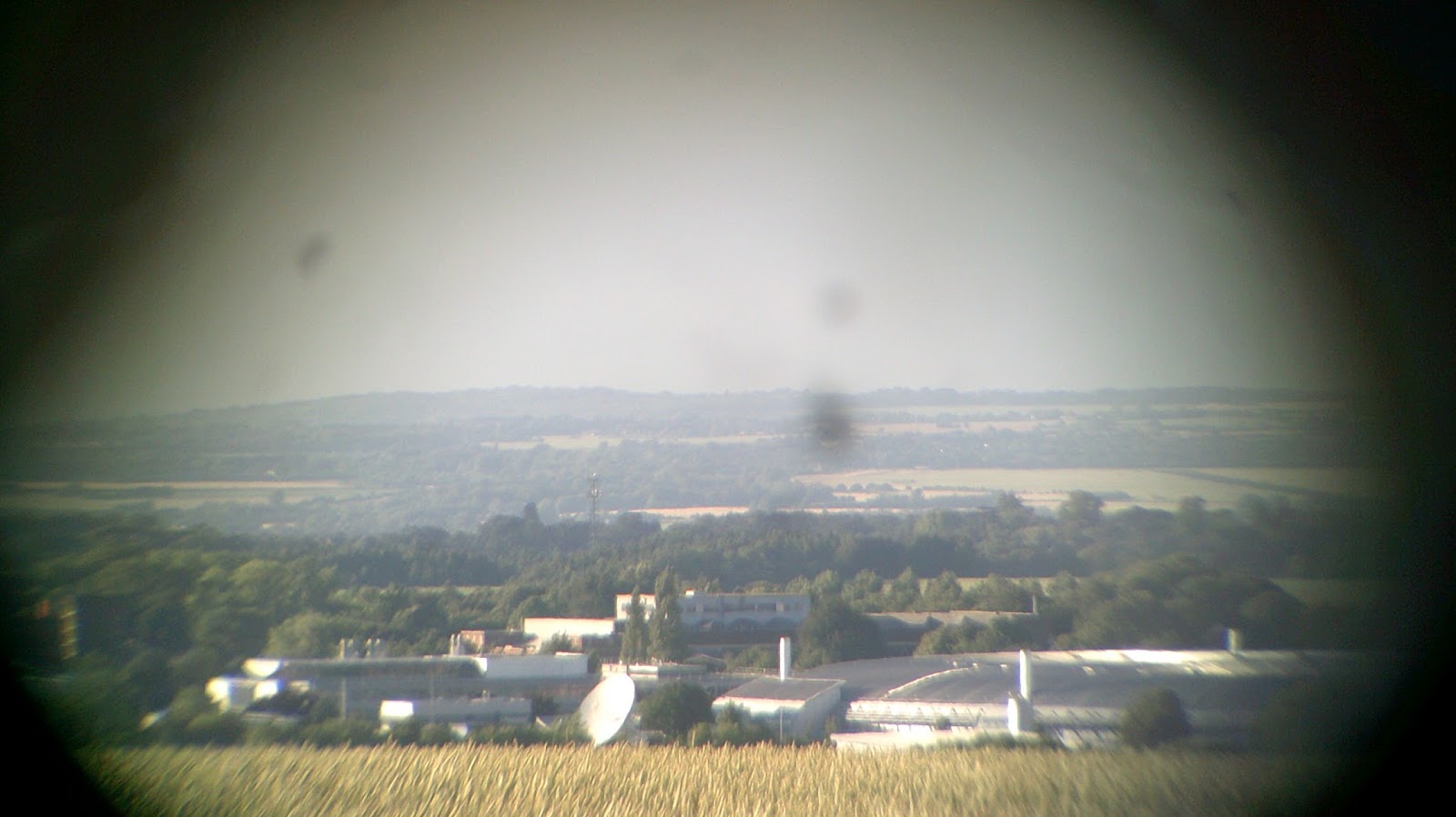
Here are some pictures taken from the Ridgeway, one of the most ancient travel routes in England. We were on Bury Down looking north across the plain to Oxford. It's a very physics-y landscape now. On the left is the Diamond synchrotron, where they accelerate electrons around a ring to generate high intensity X-rays with the aim of discovering the structure of molecules. It is part of the Harwell site, where a lot of research into civil nuclear power was done. On the right is Didcot power station.
 

I used the fact that the quantum efficiency of the charge coupled device (CCD) on the back of a digital camera (at 70%) is much higher than that of old-fashioned film (at 4%). I was able to take the following photographs through my binoculars. You wouldn't be able to do this with an old-fashioned camera because the optics of the binoculars reduce the intensity of the light. Only 4% of photons entering the camera are recorded anyway, so 4% of fewer photons makes for no picture. As you can see, 70% of fewer photons produces a decent image.


Thursday, 1 August 2013

The physics of a christening

I went to a christening down south. There had been a service before hand and the air was heavy with incense. Looking up I saw was reminded that light travels in straight lines! It's like using a little milk in water to show up a laser beam.
 
 
The font had a heavy carved wooden cover on it. You might be wondering how it comes to be hovering in mid-air in this photograph.

 
The answer will lie in the metal cross shown in this photograph. I would imagine that it will have the same weight as the wooden font cover. They are at opposite ends of a chain which hangs over a pulley. When one goes up, the other must come down. Hence as you do work lifting the font cover, gravity does work on the cross to lower it. The only energy needed in the system is that required to overcome the friction of the chain and the pulley. It becomes easy to lift the heavy wooden cover.


Saturday, 20 July 2013

Time on other planets

An amazing feature at Jodrell Bank was the display of clocks in the café. The clock for Venus goes backwards because it rotates the wrong way. It is also very hard to see the second hand moving because a day lasts longer than a year on Venus,

 
The second hand for Jupiter flies round because the planet spins so quickly.


The clock has stopped for the black hole.
 
 
These are all so very effective. But we loved the notice below for Earth because we can see the radio aerials concerned from the back window of this house. Hello, Anthorn!

Monday, 15 July 2013

Why is a radio telescope painted white?


We went to Jodrell Bank near Manchester on Saturday. It was one of my early blog posts and it has been 4 years since we went. I'd never really thought about why they had chosen to paint it white. It turns out to be because black absorbs infra-red heat radiation from the Sun most effectively. That would make the metal expand and distort the very precise shape of the parabolic mirror. They claim that the shape of the 76m dish is out by only a few millimetres in the dish.

Thursday, 11 July 2013

Fantastic images of space

We found a marvellous NASA website that gives you a different picture of space every day and explains it. Looks like a good way to learn new details about the life cycle of stars. http://apod.nasa.gov/apod/astropix.html

Wednesday, 10 July 2013

A sundog


It has taken me years to recognise this phenomenon but Wikipedia tells me that hexagonal ice crystals in high cirrus cloud refract the light of the Sun. It produces that bright patch to the right of the Sun which has the rainbow colours, suggesting the prism effect of refraction. That bright patch is the sundog or "mock Sun". In good conditions, you get one on either side of the Sun, and sometimes a circle around the Sun.