Thursday, 18 June 2015

Wearing away: Falls of Foyers


These are the lower Falls of Foyers by Loch Ness. I was struck on my previous visit by the V-shaped notch at the top of the falls. The total height of the waterfall is given as 62 metres. It's hard to photograph the whole thing. I think that the notch must be about 20 metres deep. I have reasoned that water cannot have flowed down here until after the last Ice Age given that glaciers must have been carving the edges of the Great Glen at that point. So water can only have been flowing this way for about 10000 years. 20000mm divided by 10000 years would mean a rate of attrition of 2mm per year. That's not unreasonable.
The falls really impressed a visiting Robert Burns who wrote a poem on the spot:


Wednesday, 17 June 2015

Stationary wave: Fourier series in Radley churchyard


The hedge in Radley churchyard is a wave that isn't going anywhere. If you didn't know, Radley is a village near Oxford, The wave is a type called a saw-tooth wave. The mathematician Fourier showed that all complicated wave shapes like this could be made by adding together rounded sine waves of different frequencies. This wave has a particularly vicious equation  http://mathworld.wolfram.com/FourierSeriesSawtoothWave.html but this page does have a picture showing how the rounded waves make up the saw-tooth.

Tuesday, 16 June 2015

Sun dial makes history in St Peter Port


I've blogged about a few interesting sundials. This one is more like a "history dial". It only tells the time on one day a year - May 9th - the day Guernsey was liberated at the end of the war. The shadow moves along the bench and tells you what was happening at that time of day on 9 May 1945. Since it only works on one day a year, there is no need for a gnomon of a particular angle. The only problem is that it needs to be sunny on 9 May every year. We were there on the wrong day but at least it was sunny. The Sun is higher in the sky in June so the shadow fell short of the bench.

Friday, 12 June 2015

Solar water heater at Samye Ling


There was a display about the solar water heaters at the Buddhist centre near Eskdalemuir.If you follow the pipework on the left hand side of the diagram there is a countercurrent heat exchanger. Cold water flows into the bottom of the panel. This is because the solar heat radiation raises the temperature of the water making it expand and become less dense. Hence it tends to rise by convection. Best to have the water moving in the direction of the natural current. But notice that the hot water pipe then goes into the middle of the hot water tank and goes downwards. This seems odd because a kettle heats water from the bottom. Given that colder water in the tank will tend to sink, it is best to heat water in the middle first. That lowers the temperature of the solar heated water. If it comes into contact with colder tank water at the bottom of the tank, there will still be a temperature gradient to deliver more energy to the tank. The flow of the solar-heated water is opposite to the direction of any warm convection currents in the water.

Thursday, 11 June 2015

Definitely alto

I was musing last month about altocumulus cloud on the Lincolnshire coast. I photographed this at Loch Ness. You can clearly see that there are two cloud layers and that the rippled layer is the higher of the two. The wind was moving in different directions in the different levels and at times it was hard to tell which layer was moving. The lower cumulus layer was just above the highest local mountain and so might have been 800 to 1000m. Altocumulus is between about 2000 and 6000m.

Wednesday, 10 June 2015

Angular velocity: prayer wheels at Samye Ling

We visited the Samye Ling Buddhist monastery at Eskdalemuir in southern Scotland. They have a building full of electrically turned prayer wheels. I forgot to time the rotation but it was about 20 seconds. Angular velocity is not the metres covered per second, but the number of degrees. And actually, we don't use degrees, we use another measure of angle called RADIANS. There are 2pi radians for every 360 degrees - that's about 6.28 radians. So a complete circle in 20 seconds would mean an angular velocity of 6.28/20 = 0.314 radians per second.

Tuesday, 9 June 2015

Crossing continents: a trip to Langholm


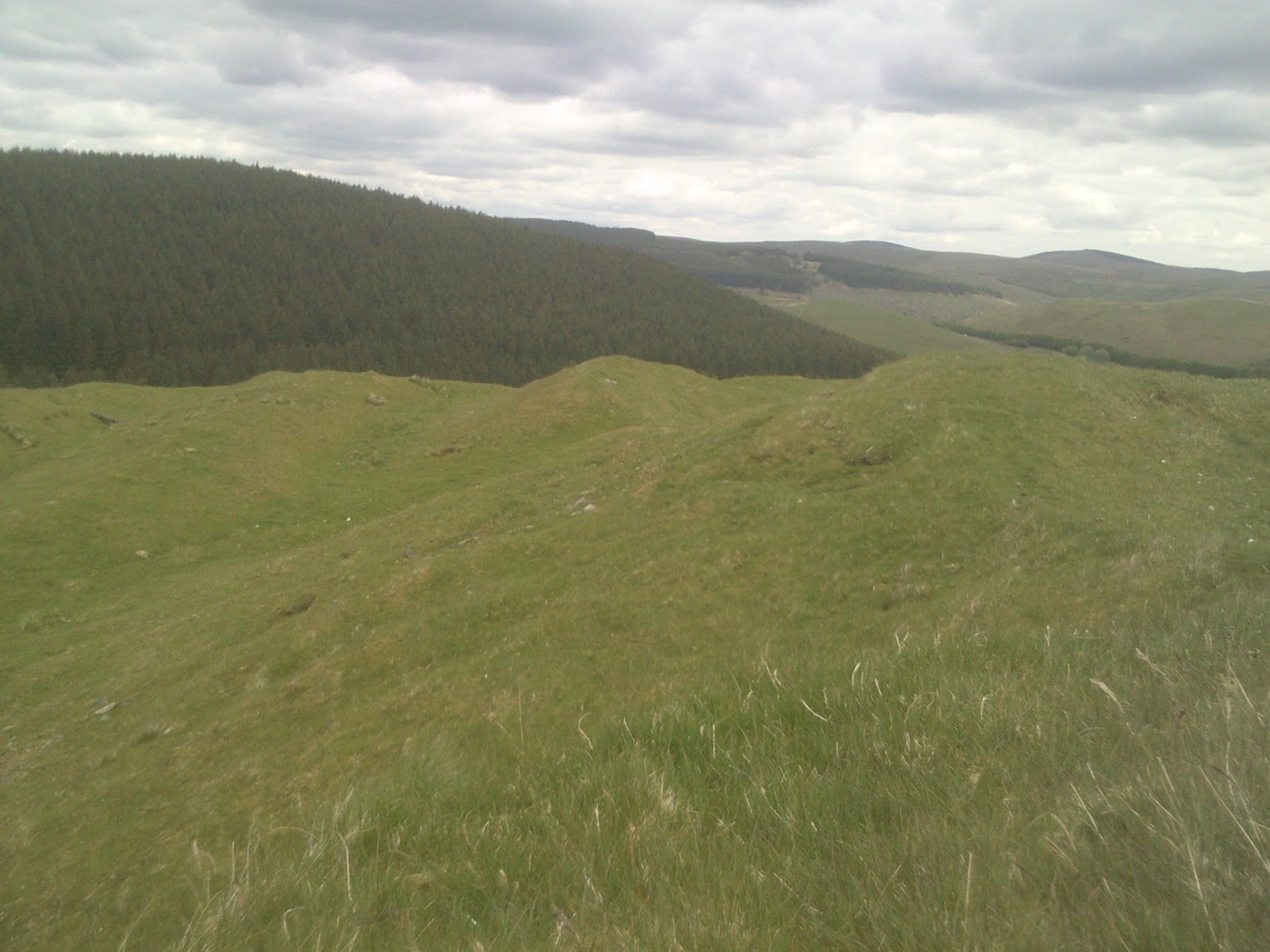
These are views from the Malcolm monument on Whita Hill above Langholm in southern Scotland. You can see our house in the views - well, I could pick out Wigton's factory through the binoculars. You can make out Skiddaw in the bottom photograph. And you can see Whita Hill and its monument from my garden. I was amazed to discover some years ago that Wigton and Langholm were on separate continents until 450 million years ago. Between us was an ocean called the Iapetus Ocean. It's roughly where the Atlantic Ocean later opened, so it was named after Iapetus who was the father of Atlas (Atlantic...) in Greek mythology. The hills on either side of the Solway weren't there when there were two continents. In fact, the hills were still mud on the edge of each continental shelf. They formed mudstones which were pushed up and metamorphosed into slates and the amazingly named greywackes due to the pressure of the collision. So Skiddaw used to be mud on the bottom of the ocean. As did these hills in the Southern Uplands taken from Bailiehill hill fort near Eskdalemuir. You can see the crumpling of the landscape caused by the collision.

It's the nearest I'm likely to get to crossing continents!