Sunday, 9 July 2017

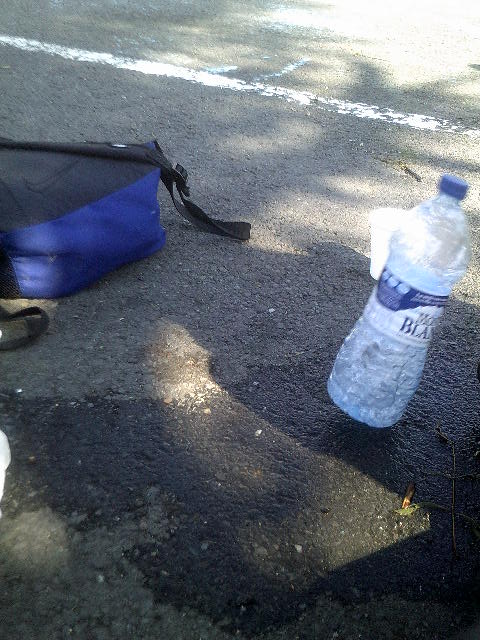
Landing the bottle whilst we waited

 We tried to land the bottle upright whilst we waited for the coach to be fixed.
 I'm no expert but my students pointed out from their experience that it depends on how full the bottle is.
 There are two bits of Physics going on. Whilst the bottle is spinning, the bottom of the bottle exerts a centripetal force onto the water to keep it moving in a circle and to stop it heading off in a straight line. The more the mass of water, the more the inertia so the bigger force needed to get it into a circle. The spinning bottle will then have more angular momentum. Momentum is a measure of how hard it is to stop something moving so with more water, the floor will have to exert a bigger force to stop the bottle.
The second bit of Physics is about stability. The bottle almost always lands on its edge at an angle. As long as the arrow showing its weight acting down through the centre of mass passes through the bottom of the bottle, the bottle will go back upright. The more water, the higher the centre of mass and the more likely the arrow is to pass outside the bottom of the bottle and tip the bottle.

Saturday, 8 July 2017

Impromptu kazoo at the chocolate factory

We made kazoos from blades of grass to entertain ourselves when the coach needed fixing outside the chocolate factory in Deauville. You pick a wide blade of grass and wedge it between your thumbs, securing it at both ends. You blow over the grass blade. The air flow is split by the grass blade. As it passes the far edge of the grass, tiny whirlpools of air called vortices form. This is called vortex shedding. They push the grass blade first one way and then the other way making it vibrate. If the frequency of vibration matches that preferred by the length of grass, then resonance occurs and the vibration is enough to be heard.

Friday, 30 June 2017

Gullet Quarry in the Malverns

 Gullet Quarry in the Malverns is a geological marvel but you can't get to it because of the fencing installed to deter swimmers. The Malverns themselves were formed as igneous rock deep underground over 600 million years ago. Later sedimentary rocks formed above them. When Africa crashed into Spain, the old igneous rocks were pushed up through the earth. There was clearly metamorphic processes at play because gneiss was formed - I didn't know it existed south of the Outer Hebrides. The sedimentary rocks eroded away more easily and that is why the Malverns stand out as a distinct range. I found out a lot from Ronald Turnbull's wonderful book, Granite and Grit. The photograph below shows pinkish rocks. This will be the pegmatite. He says "where gneiss is crushed and heated to the verge of melting down and starting all over again, the rock called pegmatite is formed". Slow cooling means even bigger crystals than in granite.
The next two pictures show the unconformity which helped geologists to work out what happened to the Malverns. The gently angled rocks in the trees are sedimentary and they are at a wildly different angle to the tilt of the igneous and metamorphic rocks.


Thursday, 29 June 2017

Kelvin-Helmholtz clouds

Trawling back through recent photos I found this one that I took at Scarborough in May. I took it because the rippled edge of cloud looked interesting. After my research into the wave clouds in Scotland, I now think that these are probably going to be Kelvin-Helmholtz clouds, but not as good as the best examples. https://en.wikipedia.org/wiki/Kelvin%E2%80%93Helmholtz_instability

Wednesday, 28 June 2017

Sands of Luce: kite buggies and components of force

We enjoyed watching the kite buggy racing on the beach at Sands of Luce. In the picture the wind is coming towards me bu the buggies are moving left and right. The kites are rigged to be pushed at an angle to the buggy's direction of motion that is less than 90 degrees. This means that you can resolve the tension in the strings to one component along the direction of motion that makes the buggy moves forward and one force perpendicular to the motion that will try to pull the buggy over. Inspection through binoculars suggests that the kite is not the same on both edges and is wing-like. Pulling on the strings means it catches the wind differently to enable the pull from left to right or from right to left. It seemed very skillful with the drivers concentrating more on the kites than the direction in which they were going!

Tuesday, 27 June 2017

More questions about the Belt of Venus


I watched the Belt of Venus for some time at sunset. It is finally beginning to sink in that these are not clouds on the horizon. The sky looks blue during the day because oxygen molecules scatter the blue wavelengths back in our direction. The Belt of Venus is the pink band between the lower grey shadow of the Earth and the blue sky above which is still fully lit by the Sun. Accounts say that it is pink because of back scattering of red light from the Sun. So why isn't red light scattered back all the time? Is it because we are low in the atmosphere at this time and dust is now important? That's what I'm struggling with. Why isn't there any blue left if it is still being lit by the Sun? I've looked at a lot of articles and not had any definitive sense. They say the Band is between 10 and 20 degrees. My fingers would roughly agree. My next source for research will be https://en.wikipedia.org/wiki/Absorption_band since the Chappuis Effect was mentioned in one forum as contributing to the grey colour below the band. This was being disputed but at least gives me something to go on.

Monday, 26 June 2017

Cloud waves over the Machars

 If you look at this view from Sands of Luce, it looks as though there are 4 evenly spaced cloud covered hills in the distance. The view below was taken a day later: there are not 4 evenly spaced hills. The original pattern looked suspiciously like a stationary wave at ground level with a fixed wavelength that must have been some miles long. The day in question was one of much visible evaporation at ground level on the beach. The air over the Machars must have been saturated with water vapour.
I have not been able to find any identical pictures but I did find this: https://communitycloudatlas.wordpress.com/category/kelvin-helmholtz-waves/ If you scroll down to the diagram of how the waves form, it looks like the picture for "small disturbances". I can make a case that there was a lower layer more dense because it was laden with water vapour and moving more slowly because of proximity to the ground. A layer of faster moving air above would lead to a wave pattern forming. I think it now helps me to understand the ribbed patterns in high clouds as well.