Saturday, 7 April 2018

Swing bridge at Falkirk Wheel: rotational dynamics


I have been wondering about how much force a human can muster in a push. Mrs B reminded me that it could be done from the weight machines at the gym. I think a mere mortal might push-list 30kg. The weight lifter winner at the Commonwealth Games was nearly ten times that! Say the bridge is 4m from the pivot to the end. For a 30kg push, the torque is 300N x 4m = 1200Nm. Moment of inertia = 1/12 ML^2 for a central axis. Here L=8m. How big is M? Suppose all the wood fitted down into 8m x 0.5m x 0.5m = 2 cubic metres. Suppose the wood floats so say 900 kg per cubic metre. Mass = 1800kg. Torque = moment of inertia x angular acceleration. So angular acceleration = 0.67 rad per second per second. Suppose it reached 0.67 rad per second after 1 second and stayed at that. To do a quarter of a turn = pi/2 divided by 0.67 = 2.3 seconds. A bit low but not ridiculous. I wish I'd timed the motion but it can't have been that small. Mass must have been bigger.

Friday, 6 April 2018

Beware golf balls

This is on the coast path from Allonby to Maryport. Golf balls have dimples to make them go further. A smooth ball does not disturb the flow of air over its surface. The air stays in fixed layers - called laminar flow. These are like onion skins of air and give the ball a larger surface area. The dimples mess up the flow of air making it turbulent. The turbulent air sticks closer to the ball reducing the surface area it presents and thus reducing drag. Some years ago I revised Reynold's Number for the laminar/turbulent transition. I need to look up how this relates to golf balls.

Thursday, 5 April 2018

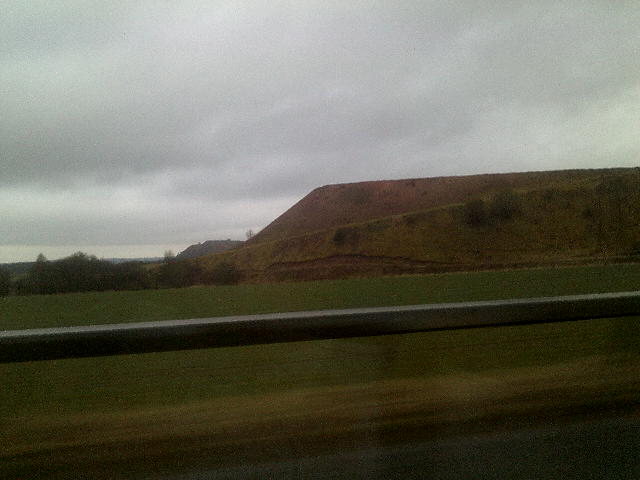
Greendykes Bing: was the shale industry energy efficient?


The landscape of West Lothian is littered with these enormous spoil heaps. The y are a relic of the Victorian shale oil industry that meant that Scotland was exporting more oil than any other nation at the time. The spoil heaps are called bings. This one is estimated to contain 15 million tonnes of waste. Another statistic is that 7 tonnes of waste rock were produced for every 10 barrels of oil. I looked up the energy in a barrel of oil https://en.wikipedia.org/wiki/Barrel_of_oil_equivalent I'm using 6 x 10^9 Joules. So 10 barrels would produce 6 x 10^10 Joules. Energy would be needed to bring the 7 tonnes of rock to the surface. If mgh = 6 x 10^10, using mass = 7000kg you get a mine depth of nearly 1000 km. Even allowing for heat energy used in the extraction process, it seems as though the oil would be worth the energy expended collecting it. Here's a lovely film showing the bing in all its glory https://www.youtube.com/watch?v=v5wiv5zobAQ

Wednesday, 4 April 2018

Thinking of overtones on the canal in Falkirk

I was amazed to find "The Undertones" still painted on a wall by the canal in Falkirk. It must have been there nearly 40 years. In Physics, we have overtones. This applies to the stationary waves produced by instruments. The longest stationary wave to fit into an instrument is called the FUNDAMENTAL MODE. It is fixed by the boundary conditions: for a guitar string that means a fixed point or node at each end. The higher frequencies that also fit in are called OVERTONES.

Tuesday, 3 April 2018

My pan is a closed system

Back to the new way of teaching energy, based on the First Law of Thermodynamics. My pan is a closed system because with the lid firmly on, matter cannot get in or out. By that I mean stuff made of atoms like water or steam. But the water inside gets hotter so something must be getting in. And that is how we get to the idea of heat and work crossing the system boundary. Since the pan is rigid, no work is done here. The new guidelines suggest breaking up "heat" into two pathways: heating by radiation and heating by particles. The shiny tin is opaque - basically imprenetrable to infra-red. So it must be "heating by particles" ie conduction.

Monday, 2 April 2018

How far away is that bird? White-winged Scoter at Musselburgh

 There's an American White-winged Scoter out there somewhere amongst the Velvet Scoter but just bobbing up above the waves for a split second at a time. Reports said 300m off shore but it looked a lot more to me. So I decided to work out how to apply the little finger trick to my telescope. The island of Inchkeith subtended half a little finger to my eye, which is about half a degree but through the telescope it took up about half the field of field.
 Conclusion is that the field of view at 40x is one degree or 0.0175 radians. Well, let's say 0.02 radians as this is all very guesstimated. I tried to photograph a duck in the distance but all I managed was a gull left of centre below. Measurements suggest it subtends about 0.0004 radians. Wingspan is about 1.20m. By the arc length rule, distance is therefore 1.20/0.0004 = 3000m. This might be inaccurate but it is clearly more than the 300m quoted. Inchkeith was 10km away as measured on a map. I can only dream of seeing the ducks that close!

Sunday, 1 April 2018

CTR Wilson in the Pentland Hills

I was very pleased to come across this memorial to CTR Wilson at the foot of the Pentland Hills near Edinburgh. He won the Nobel Prize for Physics for his invention of the cloud chamber. This blog started after a trip to Ben Nevis and it was his time as an assistant at the observatory on the top of Ben Nevis that inspired him to invent the cloud chamber. This invention was one of the earliest particle detectors and thus on the direct line of development that led to CERN. I've posted about cloud chambers before when we have had dry ice in. I found this wonderful set of anecdotes about his life https://www.rse.org.uk/cms/files/events/reports/2012-2013/CTRWilson_Conference.pdf which has a piece from someone I assume to be THE Tam Dalyell, the famous Labour MP, whose interest in science seems to have stemmed from a chance meeting with CTR Wilson.