It had never occurred to me before to try to work out a scale of what I am looking at through a microscope. I've only just heard of graticules and don't yet know if we have any. So I measured the size of the illuminated hole in the stage. It was 12mm wide.
Then I viewed the ruler through the microscope. At 4x magnification, that field of view becomes 3mm
At 10x magnification it is just 1mm wide
Also note how wide the scale divisions themselves become!
Monday, 15 April 2019
Sunday, 14 April 2019
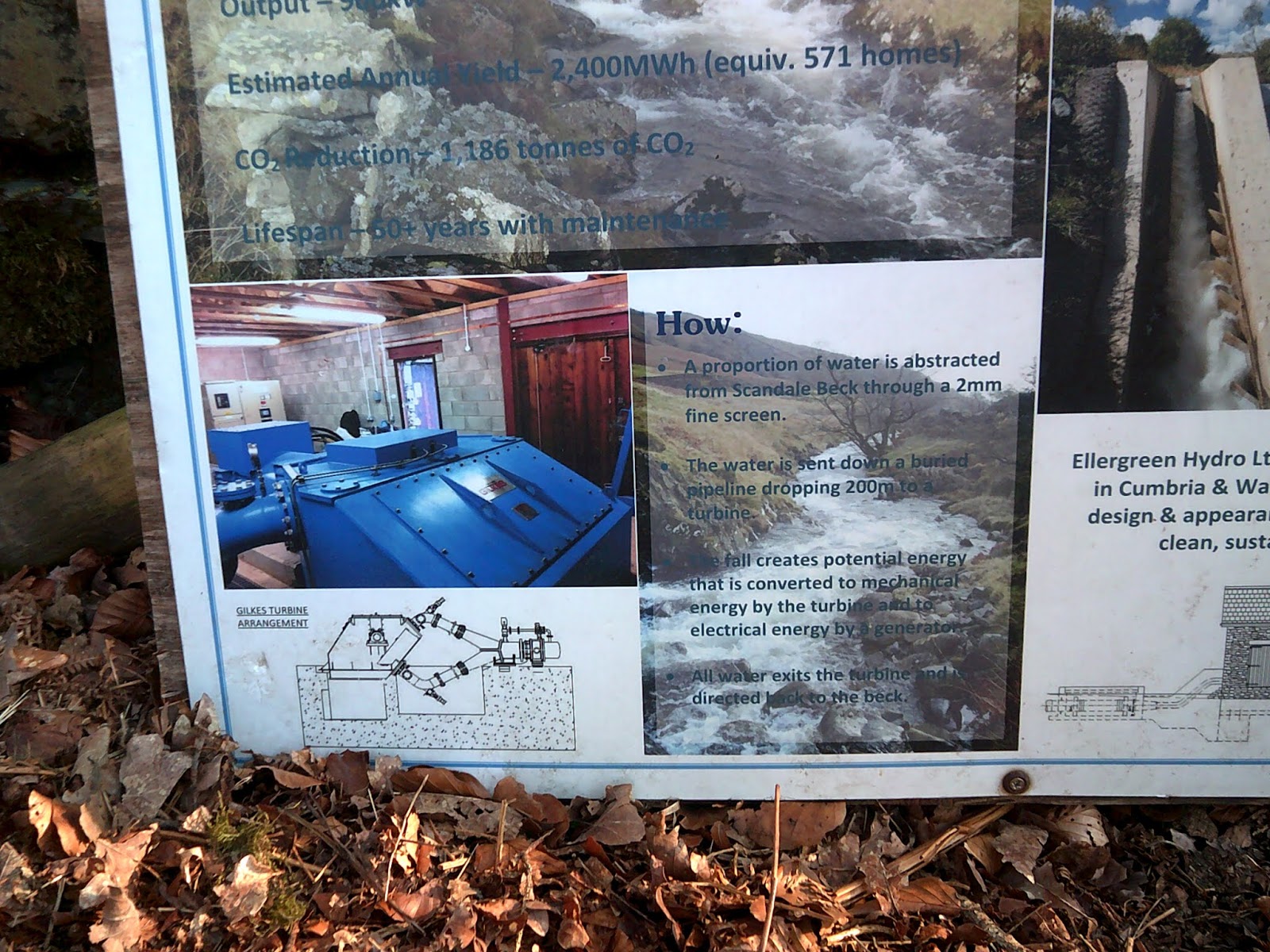
Scandale Beck hydro
We found this small hydroelectric power scheme. It is said to be the biggest such in Cumbria. https://www.itv.com/news/border/story/2015-10-09/cumbrias-biggest-hydro-electric-scheme-nears-completion/ It cost £2.8million. If 1kWh costs 12p and it generates 2400MWh a year, that would be £288000 a year and so would take 10 years to pay back. I would have thought it would be slightly more than that because some of the 12p will be needed for business running costs.
Saturday, 13 April 2019
Wingtip vortices from jet planes
The planes were even closer on Nab Scar. There's one in the picture above just below the skyline on the left. As the planes banked, they produced vapour trails on each wingtip. A vortex is like a tiny whirlpool of air The aerodynamic shape of a wing means that air travels faster above the wing than below and thus has lower pressure above the wing than below. Hence high pressure air can escape sideways around the end of the wing, looping towards the lower pressure above. Meanwhile, the forward motion of the plane drags this looping air forwards into spirals - the wingtip vortices. The spinning air is at very low pressure. It all happens so quickly that there is no time for thermal energy to flow into the vortex from the surrounding air. So that can't be the source of the extra energy to rotate the vortex. The energy has to come from the internal energy of the air in the vortex. This lowers the temperature of the air and water vapour condenses. This is what I could see. https://en.wikipedia.org/wiki/Wingtip_vortices
Friday, 12 April 2019
How fast does a jet fly?
They have been flying jets relentlessly down the Lake District valleys recently. There's one in this picture against the lowest cloud right of centre. We were on Silver Howe above Grasmere and I timed it fly from roughly White Moss Common to roughly Dunmail to try to work out the speed. It took 20 seconds. The distance is maybe 3.5 miles. That's 630 mph. The speed of sound is 767 mph. They mustn't go faster than sound because the sonic boom would break windows.
Wednesday, 10 April 2019
Solifluction or sheep tracks?
I had always assumed that these small horizontal terraces on hillsides were sheep tracks. I've been reading Derek Ratcliffe's book Lakeland about the natural history of the district and he mentions that a process called SOLIFLUCTION can result in small terraces. He calls it the "frost-sorting of soils and debris". He says that it is due to a freeze-thaw cycle and forms strips of stones with ridges of soil on slopes. He does say it is better on Skiddaw Slates than on Borrowdale Volcanics. This picture above Watendlath is the latter so maybe this is the work of sheep. I now know to look out for solifluction lobes, which don't look like sheep tracks. Sources of pictures that made me wonder are: https://www.alamy.com/stock-photo-possible-example-of-solifluction-soil-fluction-dorset-england-43306329.html and https://www.geograph.ie/photo/475616
Sunday, 7 April 2019
Single Pole Double Throw Switch gate in Langdale
This gate on Side Pike in Langdale reminded me of a Single Pole Double Throw switch, otherwise known as a landing light switch. It's the way that the gate pivots in the middle but can close to the left or the right. It just looks like the circuit symbol representation. You can find that here https://learn.sparkfun.com/tutorials/switch-basics/all It's decades since I had to teach it but even when I did, I didn't know that single pole means one single circuit connected but double throw means two "on" positions - hence the landing light.
Monday, 1 April 2019
Static shielding bag for my diodes
I've taught about methods of protection against humans charged with static electricity, and now I've an example in my hands. My synthetic layers often produce sparks and the voltage would exceed the breakdown voltage of the diodes. Hence the bag is conducting. I guess that means that it acts as a Faraday Cage https://en.wikipedia.org/wiki/Faraday_cage I tested the bag with an Ohmmeter expecting to get a low resistance but was off the scale, even on the kOhm settings, so perhaps I've misunderstood. A resistance like that is more like an insulator than a conductor.
Subscribe to:
Posts (Atom)