Wednesday, 7 November 2018

Bradwell: First nuclear power station to be decommissioned


We went to see the war memorial at the former RAF Bradwell in Essex. The site became a nuclear power station after the war. It was the first in the UK to be decommissioned, being turned off in 1962. It generated 242MW across two units. There are now onshore wind farms that can generate as much as one of those units, but not with the continuity or compactness of supply. https://en.wikipedia.org/wiki/Bradwell_nuclear_power_station https://en.wikipedia.org/wiki/Arecleoch_Wind_Farm

Sunday, 4 November 2018

Diffraction grating net curtain

 Here is the light reflected from a car through a lace curtain. The cross shape is the result of diffraction by the horizontal and vertical fibres.
The pattern is roughly 1 degree wide. I could see two orders of fringes on either side of the central maximum. Red was the furthest out and violet closest to the centre.
I examined the weave with a magnifying glass and a ruler. There were approximately 4 holes per mm. Using the equation n.lamda = d.sin(theta), then d is approx 0.25mm. For first order fringe, n=1 and theta will be about 0.25 of a degree. That would give a wavelength of about 1000nm to 1 sig fig. That is very close to the range for visible light of 300 - 700nm. Not bad for a ruler and a little finger.

Saturday, 3 November 2018

Handleless coffee cup

I was a little bit perturbed to be handed what looked like a glass of hot coffee but it turns out that the bottom of the cup is a double layer of plastic trapping air. The trapped air is a good insulator because the air molecules are not joined together - they are actually quite far apart - meaning it is hard to pass extra kinetic energy one to another. Trapping it means that energy transfer by convection is also prevented. Reduced heat flow means that the outside is cool enough to grip safely.

Friday, 2 November 2018

Magnetic attraction weakens with separation


I got this experiment from an exam question. I taped a 0-10N spring balance to a bar magnet and had it attract a second bar magnet. I measured the force needed to pull them apart. Then I added card between the magnets and measured the force again. It took about 4 bits of card until the force of attraction between the magnets was too weak to measure.

Thursday, 1 November 2018

Brillouin-Wigner perturbation theory part 2

What I'm doing here is trying to do the workings to prove the results in the document linked to yesterday's post -seeing if I can follow the workings and understand it.
First we add a perturbation to the original Hamiltonian Ho. Most other methods I've seen use V instead of H1 because the perturbation is thought to be a potential energy from some external field.
 Now here I have one problem. I thought En was a number - an eigenvalue that tells us the measurable energy - but it is having the original Hamiltonian Ho subtracted from it. Perhaps it is En x identity matrix. We had something similar in yesterday's workings where the Hamiltonian was given as the sum of eigenvalues En x Pn. Pn is a matrix. He does say at the top of the document that the curly small Es are eigenvalues and En is distinct so my hunch may well be correct.
 Again below I'm not quite sure where the Pn in the summation for Ho on the bottom disappears to.
 I can follow this bit. It assumes that perturbed and unperturbed eigenkets are in the same direction, but I think that is the idea with the small perturbation. The energy values change but not the ket direction.
 So we finally get to write perturbed state in terms of the unperturbed, which confirms my last comment.
More maths to follow to work out the perturbed energies En.

Wednesday, 31 October 2018

Brillouin-Wigner Perturbation Theory Part 1

I've been working on trying to understand part of Quantum Mechanics. There are only certain simple systems for which it is possible to solve the maths of Schrodinger's Equation. Ordinary maths won't solve more complex problems so the idea of Perturbation Theory is to change the energy by a small amount - give it a nudge - do some maths on that and come up with a solution written in terms of the original eigenstates of the system, because it won't have changed much. To work out the Brillouin-Wigner version of it (as opposed to the Rayleigh-Schrodinger version that we have looked at in the past) I've been using this document http://www.phys.ufl.edu/~kevin/teaching/6646/04spring/bw.pdf  What I decided  to do was to write the ket-vectors as if they were 3-dimensional real vectors and do matrix work based on them to get a feel for what the symbols actually mean. The ket vectors |n> are orthonormal eigenstates - in other words, if you do the inner product of one with another, the answer is zero. Each has its dual, the bra
 The inner product of a ket with a bra turns out to be a matrix. The document calls this one P1 and calls it a PROJECTION OPERATOR. (Remember that operators are matrices)
 The second projection operator is Q1. It is the identity matrix - P1. It says that P1 and Q1 are complementary.
 I have also proved that Q1=P2+P3 so for any number of n, Pn=sum of Qm, provided you miss m=n.
Then I tackle the idea that the Hamiltonian is also the sum of these projection operators multiplied by a factor. He calls this the SPECTRAL REPRESENTATION of the Hamiltonian - in other words, breaking the whole down into the bits that it is made of like white light is broken down into the component wavelength colours.
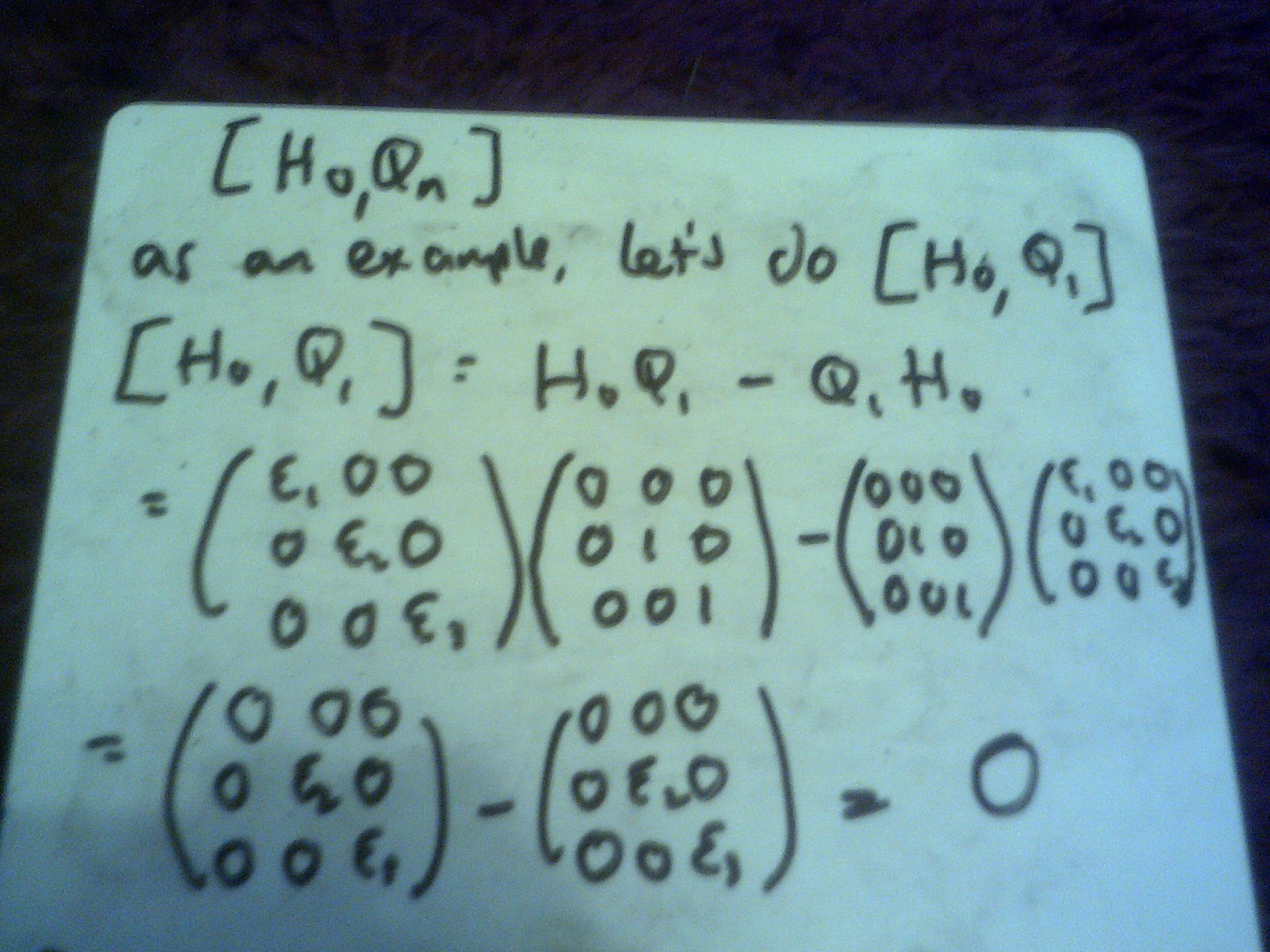
 I've got as far as the commutator proof. The Hamiltonian commutes with the other projection operator Q.

Tuesday, 30 October 2018

Flatford Mill: group velocity


Something caused these circular ripples at Flatford Mill, scene of The Haywain. What was noticeable is that the wave group stayed together and did not disperse from each other as they spread out. Looking it up https://en.wikipedia.org/wiki/Group_velocity that must mean that there were waves of only one frequency within the group. It suggests that the group velocity must equal the phase velocity.