Saturday, 28 February 2015

Sundial and marmalade at Dalemain

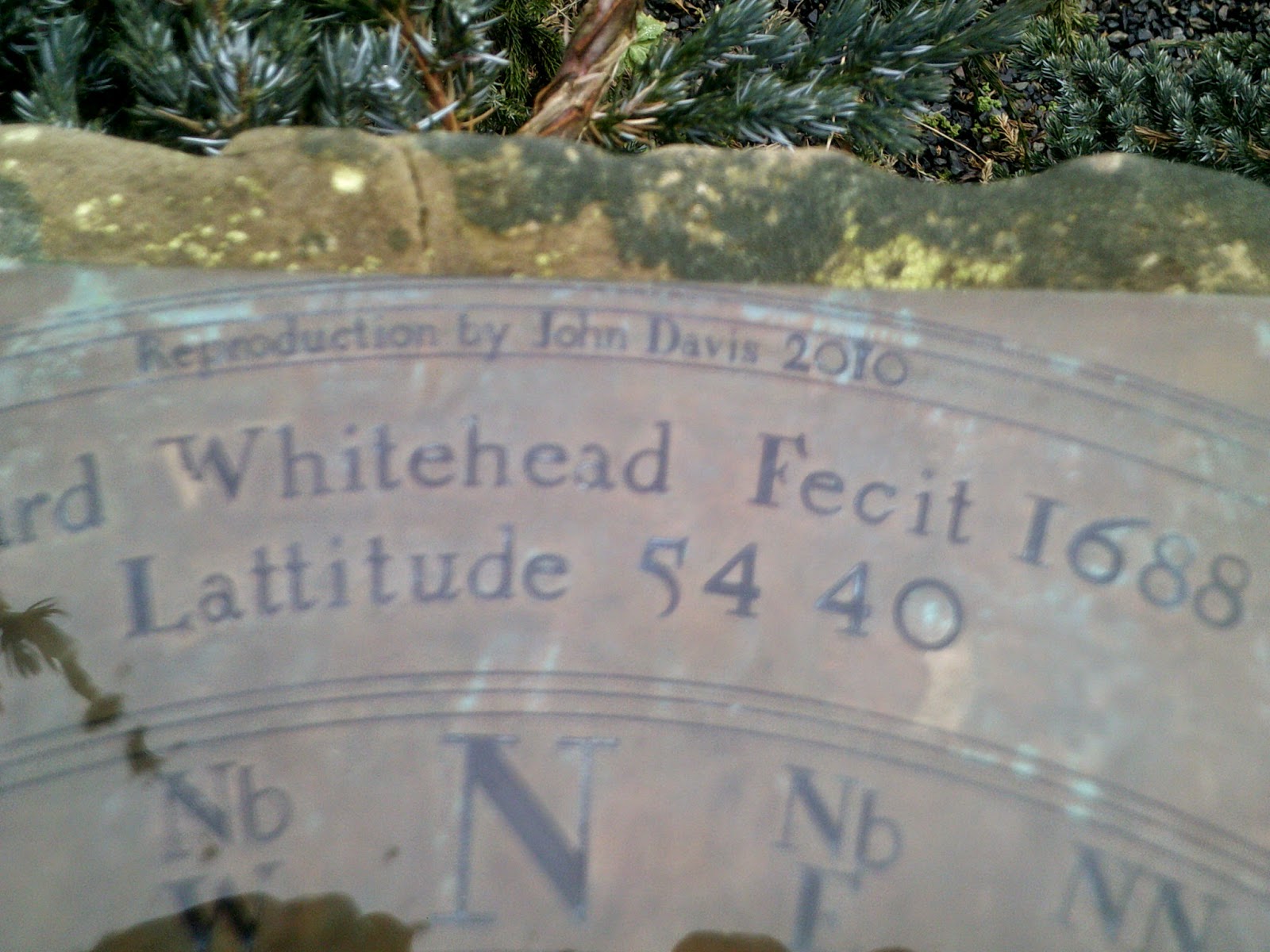
We went to Dalemain House near Penrith for the wonderful marmalade festival and found this lovely old sundial. It had markings on for the minutes as well as hours.
 The best bit was that it tells you the latitude (note the old-fashioned spelling).
 Which meant that I had a chance to check the thing that I discovered just before Christmas... that the angle of the slanted gnomon to the horizontal should be the same as the degrees of latitude north of the equator. I wasn't carrying a protractor so I tried to photograph it as square on as possible. On my screen, it measures as 56 degrees which suggests in real life it will be the same as latitude. I'm still thinking about what happens on the equator where the latitude is 0 degrees.
 Mrs B's first ever marmalade scored 15/20 which was a triumph. I posted a few weeks ago about the thermometer used in its production.
 

Friday, 27 February 2015

Braking distance experiment

First of all we set the ramp to a particular height measured from the floor with a metre stick.
Then we let the trolley roll down the ramp into the box.
 The trolley was stopped by friction between the box and the floor. We measured how far the box slid. We found that the higher the ramp, the faster the trolley and the further the box slid. It's like the braking distance for a car which is also due to friction.
 Then we taped a 1kg mass to the trolley. It slid further each time.
When we repeated with 2kg, it went even further. Heavy vehicles and fast vehicles have bigger braking distance.

Thursday, 26 February 2015

Riemann sphere

I posted last month about Riemann surfaces. The Riemann sphere is a simple Riemann surface. I made a model of it to help me to understand it.
First, a quick recap. You can't get an answer for the square root of a negative number. Try it on your calculator for square root of -1. You get "Math ERROR". But someone was brave enough to break the rules and pretend that the answer existed. So the answer was called an IMAGINARY number and square root of -1 is called i. i stands for imaginary.
You can then make up COMPLEX numbers which include a real number and an imaginary number eg 1 + i or 6 + 4i. Someone then suggested plotting these like you would plot x and y on a graph. The x-axis gets the real number and the y-axis gets the imaginary number. The graph is called the complex plane. A Riemann sphere is a technique for turning a flat piece of complex plane graph paper into the curved surface of a sphere instead. Here's a picture of a flat complex plane with a glass sphere above. I have placed a light bulb at the north pole of the sphere. I marked an x on the glass. The light shines through and makes a shadow on the flat complex plane. These two points are the same - it's just one is plotted on a flat surface and the other on a curved surface.
Next I drew a line round the equator of the glass. I went over the shadow on the flat surface with a red pen. We call this the "unit circle" on the complex plane. The circle has a radius of one unit. Points drawn below the equator on the glass appear inside the unit circle. They are less than 1 - in other words they are fraction. If I use the letter z to represent any complex number, the points below the equator must be 1/z to be fractions.
Next I did the thing the other way round. I marked a point 1 + i on the flat surface and worked out using shadows where the same point would appear on the curved surface. Notice that it is above the equator.
The further up the sphere you mark a point, the further from the origin of the graph the shadow appears on the flat graph. If you think about it, by the way that light makes shadows, two points close together near the top of the glass sphere will end up a long way apart on the flat plane. The conclusion is that the light must have been placed at a point representing infinity. The beauty of the Riemann sphere is that it takes a infinitely big flat plane and maps it onto a finite surface of a sphere. An infinity can be represented by a single point at the north pole.
Now I understand the construction, I need to know what it is used for! Back to Roger Penrose's book! And many thanks to my technicians for coming up with the perfect spherical flask for the photographs!

Wednesday, 25 February 2015

Derwent Water as a ripple tank

 I use a ripple tank to show the properties of waves to my classes. Today Derwent Water was acting as a ripple tank. The waves were coming in towards me as I took the picture. The straight edged waves appearing in the picture would be called plane waves. They hit the smaller rocks close to the shore and that produced circular ripples that were reflections. Reflection should produce waves with the same wavelength but if you enlarge the photograph above, you'll see a disturbance in the water between the nearest rock and the National Trust Centenary memorial. There was a small rock coming in and out of the water. The circular ripples it produced had a smaller wavelength than the plane waves coming in. There can be two reasons for this. One is that there is a refraction effect and that the waves are slowing down in shallower water around the submerged rock. I saw no evidence of the plane waves bending though. The second reason would be that the rock was being hit at a higher frequency than the way the plane waves were formed. This might be the answer because of the way that the rock was sometimes submerged and sometimes out of the water.
The bigger rock in this picture was never submerged and seemed to produce circular ripples with a wavelength closer to that of the plane waves.

Tuesday, 24 February 2015

Have I proved Newton wrong?

 I set out to investigate Newton's 2nd Law using this apparatus. The light gates were connected to a computer to calculate the acceleration. All I had to do was to sort out the forces. I had the trolley pulled along the ramp using weights hanging on the end of a string. The trouble is that as the trolley rolls along the ramp there is friction which acts as a counter force. The overall force on the trolley, the RESULTANT FORCE is weight - friction. I only wanted the weight: I needed to get rid of friction. I decided to cheat as shown in the picture below. I propped the ramp up with books so that the extra bit of gravitational pull cancelled out the friction. Or so I thought! (This method is called FRICTION COMPENSATION)
Here are my results:
The force is in the left hand column. I used a mass of 2kg so 2kg multiplied by the acceleration should equal the force according to Newton's 2nd Law. That clearly hasn't worked! Have I proved Newton wrong? I won't be sending a paper to PRL anytime soon... I must just have got my friction compensation wrong.

Monday, 23 February 2015

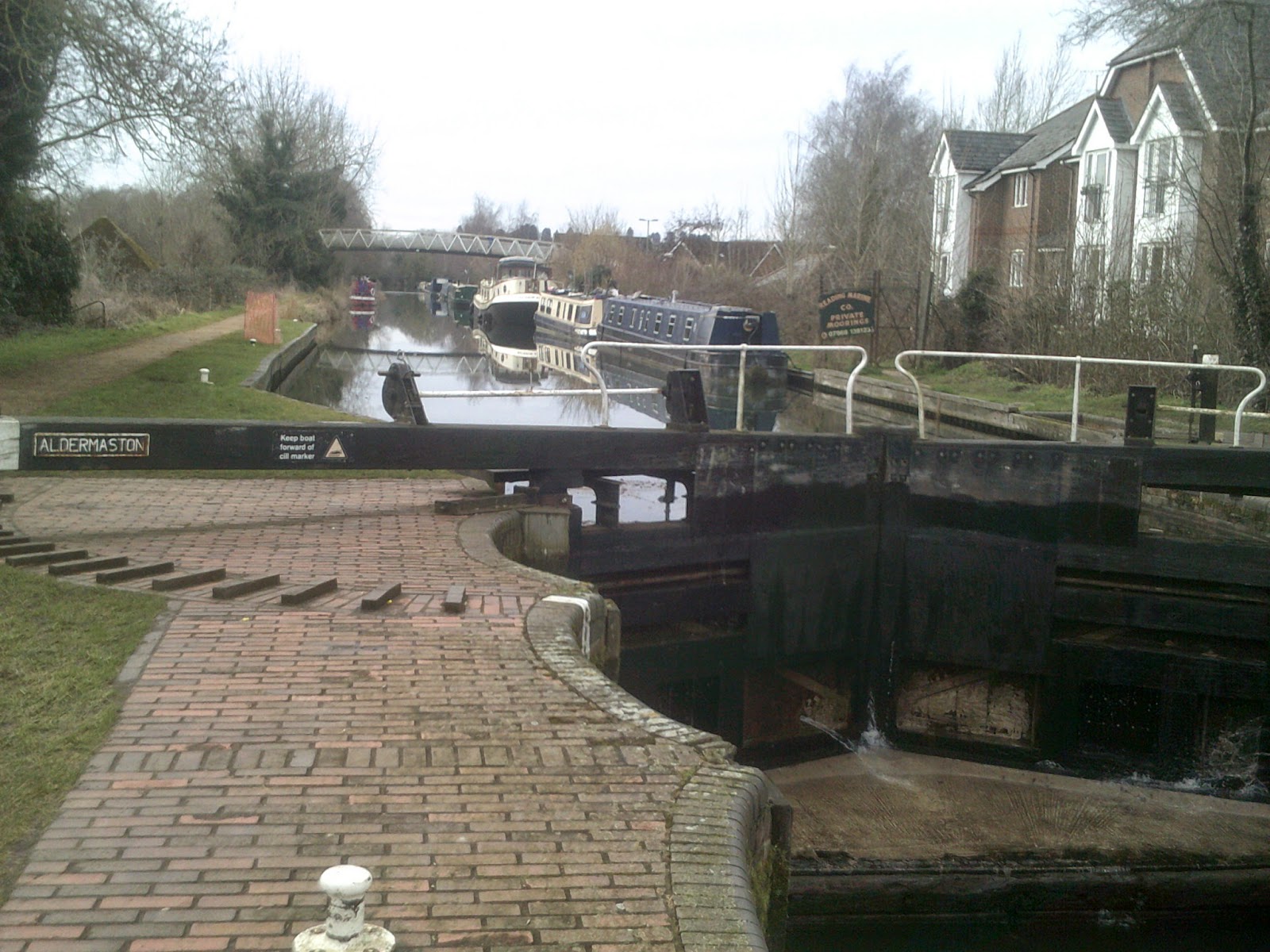
Efficiency question: the lock at Aldermaston Wharf

 There aren't any canal locks in north Cumbria. This one is in Berkshire. Canals were waterways made by people about 250 years ago to move large amounts of heavy stuff like coal. They were superseded by railways. How do you get a boat to go uphill? That's where the lock comes in. Start with the top picture. They open the gates and sail the boat in. They close the gates behind them. Now look at the picture below. Small panels in the bottom of the gate are opened and water pours in. This raises the boat to the top level. The gates are opened and the boat sails off.
 1. The boats are called narrowboats like the black one in the picture. I have read that their mass is 1000kg for every metre of length. How heavy is the narrowboat?
2. The narrowboat gains gravitational potential energy mxgxh by being pushed upwards by the water pouring into the lock. Calculate the gravitational potential energy gained by the boat (say g=10 N/kg because we are estimating quantities)
 3. The energy to raise the boat comes from the water that falls into the lock from the higher section of the canal. That water loses gravitational potential energy. Calculate the mass of water that falls into the lock by estimating the volume of water needed to fill the lock up to the higher level and then using the fact that 1 cubic metre of water has a mass of 1000kg.
4. Next calculate the potential energy lost by the water as it goes in by using mxgxh.
5. Calculate the efficiency of the lock by working out what percentage of the gravitational potential energy lost by the water is given to the boat.

Wednesday, 18 February 2015

Souther Fell - no sign of the spectral army

Wainwright's guide to the Northern Fells reports that in 1745, an army with horsedrawn carriages was seen along the top of this hill. It took 2 hours to pass and seemed to disappear over a cliff. If you Google it, you'll find that it happened more than once. They went up to look for evidence and found no trace in the marshy ground. An army of ghosts, then: spectres.Wainwright suggests that it could have been a mirage. Mirages are due to refraction when different layers of air have different temperatures. The different temperatures mean that each layer has a different refractive index. Colder air has the higher refractive index, thus light bends towards the normal line as it passes into colder air. The classic desert mirage has the hottest air nearest the ground due to the heat of the desert sands. The light can experience total internal reflection as it comes down from the colder air above and thus bend back up towards the observer. Your brain thinks light has gone straight so it appears to you that an object is below you when it truth it is above. Yes there are clearly different temperature bands as you go up a mountain. It was Midsummer Day when the spectral army was seen which might warm the atmosphere more. But I've not experienced any mirages in my years in the mountains. We saw no ghosts.