Saturday, 2 April 2016
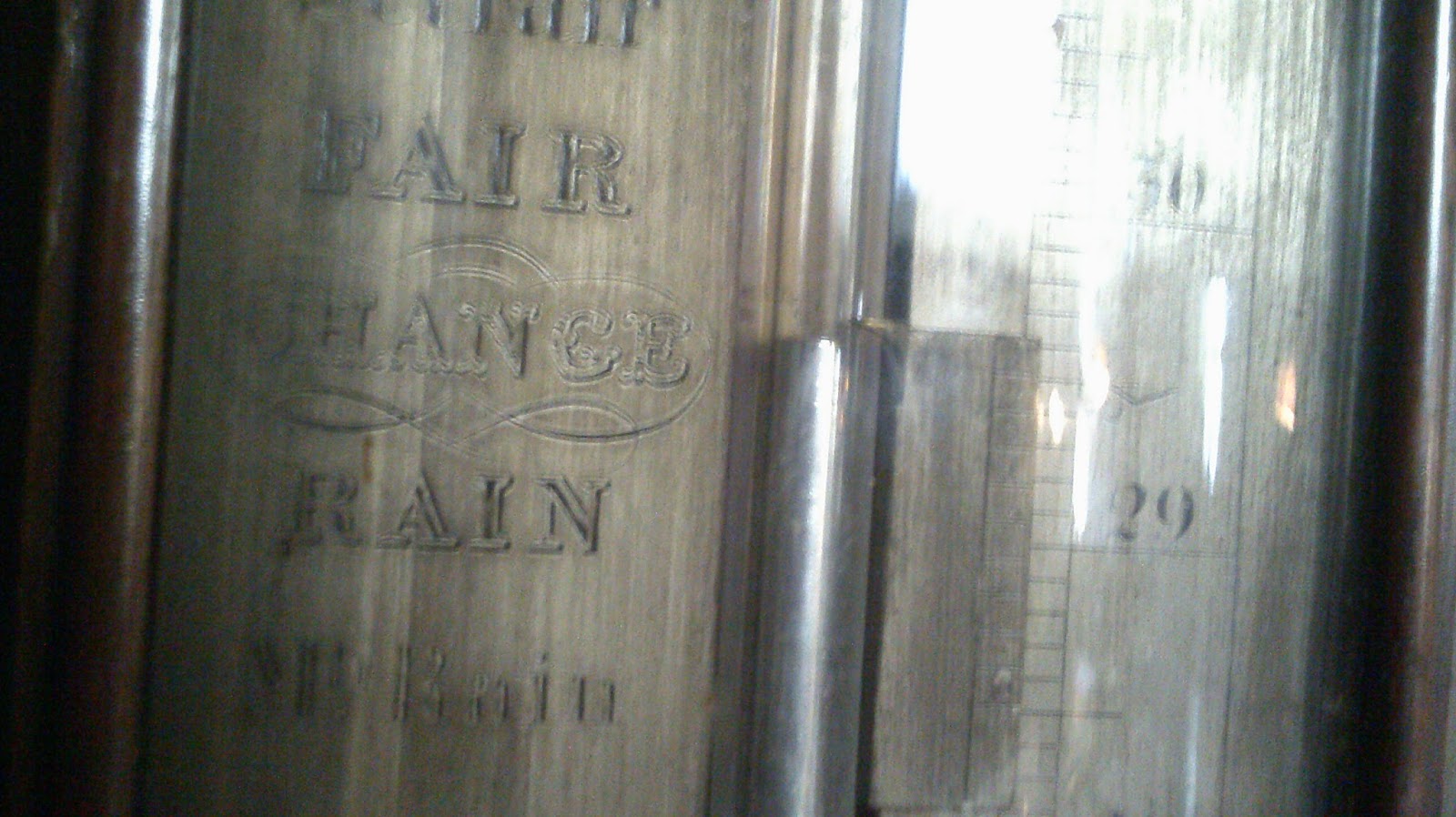
Mercury barometer at Chastleton House
Chastleton House is a wonderful Jacobean manor house between Chipping Norton and Stow on the Wold. It's charm is that it has hardly been altered over the years because the family ran out of money. I found this mercury barometer. You make them by getting a tube about a metre long with one end closed. You fill it with mercury. You cover the open end and invert it into a tub of mercury. Air pushes down on the open tub of mercury but not enough to support a metre of mercury, so the mercury sinks down the tube. It settles to a height supported by air pressure and does up and down a bit as air pressure varies. As befits an old house, the scale is in inches. But I was really impressed by the Vernier attachment. The top of the attachment points to a reading of 29.6 inches. You then go down the Vernier until its scale divisions line up with those on the inches scale. That's 2 scale divisions, which means that we can say more precisely that we have 29.62 inches of mercury. I'm interested that it was done in tenths of an inch. *For the record - mercury vapour is poisonous so don't make you own ....!*
Friday, 1 April 2016
Zodiac clock at Snowshill Manor
Snowshill Manor in the Cotswolds is well-known for the bizarre collection of hand-crafted objects collected by Charles Wade. I liked this one in the garden. It's an astronomical clock. I didn't think enough when I was there to figure it out although I was surprised that the outer scale numbers to 12 twice. I had thought it just told you the current star sign. Looking at other pictures of it on Flickr, I think that the whole inner circle with the star signs on must rotate and that the Sun on the end of its hand is supposed to make one complete rotation every 24 hours, carrying the Zodiac dial with it, That's my hypothesis! If I ever go again, I'll ask. The constellations of the Zodiac are merely those on the same plane as the planets. I think the current star sign is supposed to be the constellation that is directly behind the Sun now.
Thursday, 31 March 2016
Cloud streets at Croome Court
We visited Croome Court in Worcestershire on a day where the cumulus clouds we forming into long lines parallel to the wind direction. These are called cloud streets. Cumulus is formed by convection. As the warm air rises, it cools and can hold less water vapour before becoming saturated. The process of condensation releases thermal energy by latent heat. This further drives the convection at the level of the clouds resulting in the fluffy tops of the clouds. I read a source that said that the neatly spaced rows of cumulus were caused by "longitudinal roll vortices". Hmm... In convection, when warm air rises, colder air sinks to form continuous loop. So the warm air rising at cloud level due to the latent heat must cause some colder air to sink somewhere. My guess is that colder air coming down is what separates the rows making circulation (vortices) that are stretched out longways (longitudinal).
Wednesday, 30 March 2016
This duck sounds like a Geiger counter
Spotted at the Wildfowl and Wetlands Trust centre at Slimbridge near Gloucester. Is this a Physics duck? And, yes, it does sound a bit like a Geiger counter. We do occasionally get them on the Solway,
Tuesday, 29 March 2016
Mirrors for X-rays at Diamond
How do you get X-rays to reflect from a mirror? X-rays go through most things and the shadows of bones are caused by X-rays being absorbed, not reflected. The answer is to fire them in at a very tight angle to the surface. In X-ray telescopes, they are called "grazing mirrors" because the X-rays graze the surface. You can see the effect with glass. Looked at straight on, light is transmitted through and you can see what's on the other side, But look along the surface of the glass obliquely and you see a reflection. The poet George Herbert summed it up in a hymn from 400 years ago, before more gender inclusive language I'm afraid: "The man who looks on glass on it may stay his eye, or if he pleaseth through it pass and then the heavens espy".
Friday, 25 March 2016
NPL time signal at Anthorn
I've been looking at these aerials every day for over 10 years but I haven't paid much attention to how they work. It occurred to me today that it isn't the masts that you can see from Wigton that transmit the waves but the wires strung between them. In the picture it is possible to see vertical wires from the ground going up in front of the most distant right hand mast. They then make a T-shaped antenna with horizontal lines. The signal must be being fed from the ground station. By making electrons in the wires vibrate, you can generate an electromagnetic wave. Such dipole antennae have a half wavelength along the top of the T. The masts are 227 metres tall. The distance between the masts is bigger than this - perhaps 500m - which would give 1000m for the shortest wavelength of LF radio waves and would give a frequency of 300 kHz. This sounds right for data on the Rugby masts which used to house the time signal. The radio waves set the time for radio controlled clocks around the country. The time itself is fixed by the NPL National Physical Laboratory in London.
Thursday, 24 March 2016
Two TV programmes to watch on the iplayer
There have been two excellent Physics programmes on the BBC this week which will be available to watch on the iplayer for the next month.
1. Jim Al-Khalili did star formation. http://www.bbc.co.uk/programmes/b0754t74 I was really taken with it because he filmed a lot of it in the Canary Islands in places I visited at Christmas! It's a great programme.
2. Last night the Horizon strand on BBC2 covered attempts to produce anti-gravity. It's a good programme for the scientific method as claims are tested rigorously. There's also a nice bit about dark energy in there. http://www.bbc.co.uk/iplayer/episode/b0752f85/horizon-20152016-2-project-greenglow-the-quest-for-gravity-control
1. Jim Al-Khalili did star formation. http://www.bbc.co.uk/programmes/b0754t74 I was really taken with it because he filmed a lot of it in the Canary Islands in places I visited at Christmas! It's a great programme.
2. Last night the Horizon strand on BBC2 covered attempts to produce anti-gravity. It's a good programme for the scientific method as claims are tested rigorously. There's also a nice bit about dark energy in there. http://www.bbc.co.uk/iplayer/episode/b0752f85/horizon-20152016-2-project-greenglow-the-quest-for-gravity-control
Subscribe to:
Posts (Atom)