Sunday, 26 November 2017

Diffuse reflection at Carraig Fhada, Islay


Two new words have appeared on the GCSE Physics syllabus - speuclar reflection is for when all reflected rays are parallel to each other and make a coherent reflection. Diffuse means that the reflection is from a rough surface. For each ray, angle of incidence = angle of reflection. Even if the incident rays go in parallel to each other they won't all have the same angle of incidence because the of the uneveness of the surface. The reflected rays will not be parallel to each other. The waves were driving in from the left in the middle picture. look how rough the profile of Carraig Fhada is. Diffuse reflection was making for a rough sea that day.

Saturday, 25 November 2017

Delezenne Circle

This is an amazing piece of equipment. The Earth's magnetic field passes through the wooden circle, which contains a big coil of wire. Flux from the Earth passes through the coil. Hence there is flux linkage - which is defined as number of turns on the coil x flux. There is a handle at the top which I managed to cut off in the photograph. If I rotate the handle, the wires spin in the flux. Imagine a quarter turn through 90 degrees from full flux linkage with all of the flux passing through the coil to a point at which the coil is parallel to the flux and no flux passes through the coil. Faraday's Law states that induced emf = change in flux linkage/time taken. An emf is a voltage which could be measured by attaching a multimeter to the contacts. Flux changes from N x flux back to zero in time delta t. Delta t is one quarter of the time period so it is T/4. So emf = 4N x flux/T. I rotate the coil at a steady rate and time 20 cycles. I then diivde by 20 to get T. Finally, the Earth's flux = emf x T/4N. If I want magnetic flux density B, then B = flux x area of the circle.

Friday, 24 November 2017

Moments and the slate wine bottle holder at Honnister

I really liked this wine bottle holder in the shop at Honister Slate Mine. It is not bolted down. It really is a balance bar obeying the principle of moments. A 75cl bottle will have a mass of 750g of wine. Let's make it up to 1kg including the glass.Centre of mass looks about 3cm from the pivot on the table top. Centre of mass of slate holder looks maybe 6cm from pivot which would give the piece of slate as 500g.

Thursday, 23 November 2017

Diffraction through the net curtain

The diffraction pattern from the neighbour's light was really clear through the net curtain this morning. I'm always amazed by how well net does diffract light. The cross shape is because there are horizontal slits in the net which diffract vertically and vertical slits which diffract horizontally.
I was struck by these things:
1. The bit minimum outside the central cross. There were lesser minima visible to the naked eye beyond.
2. I'm wondering why the central section is also slightly split. I suppose that the diffraction pattern is usually overlaid by an intensity pattern dictated by the single slit. Maybe that effect is just very pronounced here.
3. The colour split is very noticeable. Violet closest to the middle and red further out.

Wednesday, 22 November 2017

Black Hole at Campfield Marsh RSPB

This pipe on the RSPB reserve at Campfield Marsh reminded me of a black hole. What goes in can't come out - and a bonus is that gravity is the force pulling the water over the edge. The pipe edge would be the event horizon. It is so difficult visualising a black hole - it's a 3-dimensional star but also a singularity.Imagining a hole in the air in front of me is head-wrecking.

Tuesday, 21 November 2017

Polarised zenith at sunset in Silloth

 Silloth at sunset.
Then I remembered that at sunset, the sky above my head is supposed to be plane polarised. Looking at it with my eyes through polarising sunglasses, it seemed clear to me that the sky became darker as I twisted the filter through 90 degrees. I tried to photograph it. Not that convincing!


Sunday, 19 November 2017

Silloth amusement arcade and the Castle Crag slate heap

I love the 2p machines in amusement arcades. Here is one at Silloth. It's the way that the coins manage to build improbable structures by stacking over each other. I know that there are often bits underneath to encourage the overhangs, but even so .....
It's a kind of emergent structure. It must be possible to model it using the laws of mechanics. I was interested in the assertion below that it is not an example of complexity.

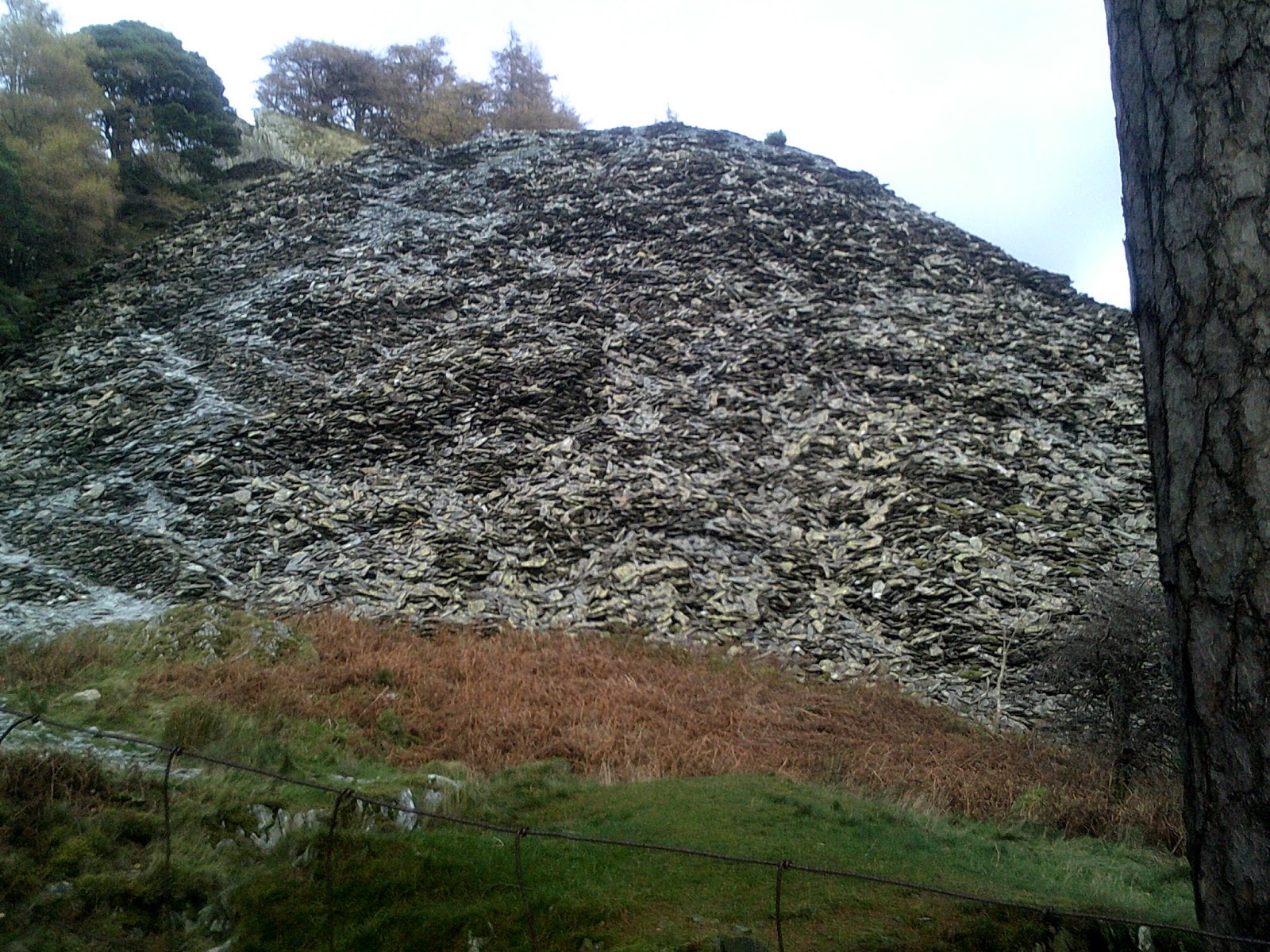
The stacked coins remind me of stacked slates in a scree. Here is an example at the former quarry at Castle Crag.