Thursday, 30 January 2020
Looking through the crystal ball
Thanks to Emily for letting me investigate the properties of a glass sphere. It turns the world upside down because refraction in the glass bends light from the top downwards and light from the bottom upwards. This is because light slows down when it goes into the glass and speeds up when it comes out. A sphere doesn't focus the light perfectly to one point but the image is clear so the multiple focal points must be close together in this arrangement. This is called spherical aberration - see https://en.wikipedia.org/wiki/Spherical_aberration for photographs.
Wednesday, 29 January 2020
Language and Quantum Mechanics: the Hopi Time Controversy
I recently finished Barry Lopez's Arctic Dreams. It's a really interesting book which I know inspired Robert Macfarlane. Lopez did a lot of thinking about the relationship of native people to the land. He is interested in their languages. In the book, he gives an example from the linguistic study of the Hopi language from much further south in Arizona. When he was writing, it was felt that the Hopi language had limited tenses so that there was little concept of past and future. The hypothesis was that they had no concept of time as distinct from space, whereas in English we can tell from the tenses used that there seems to be a linear flow of time from the past to the future. Lopez felt that this would make Hopi a great language for describing Quantum Mechanics. A little poke around on the Internet reveals that the idea has now become very controversial https://en.wikipedia.org/wiki/Hopi_time_controversy It turns out that Benjamin Whorf, who came up with the hypothesis, was influenced by Einstein, so there is some Physics feedback going on here. It looks like an interesting topic for further reading.
Monday, 27 January 2020
Diode and ac and oscilloscope
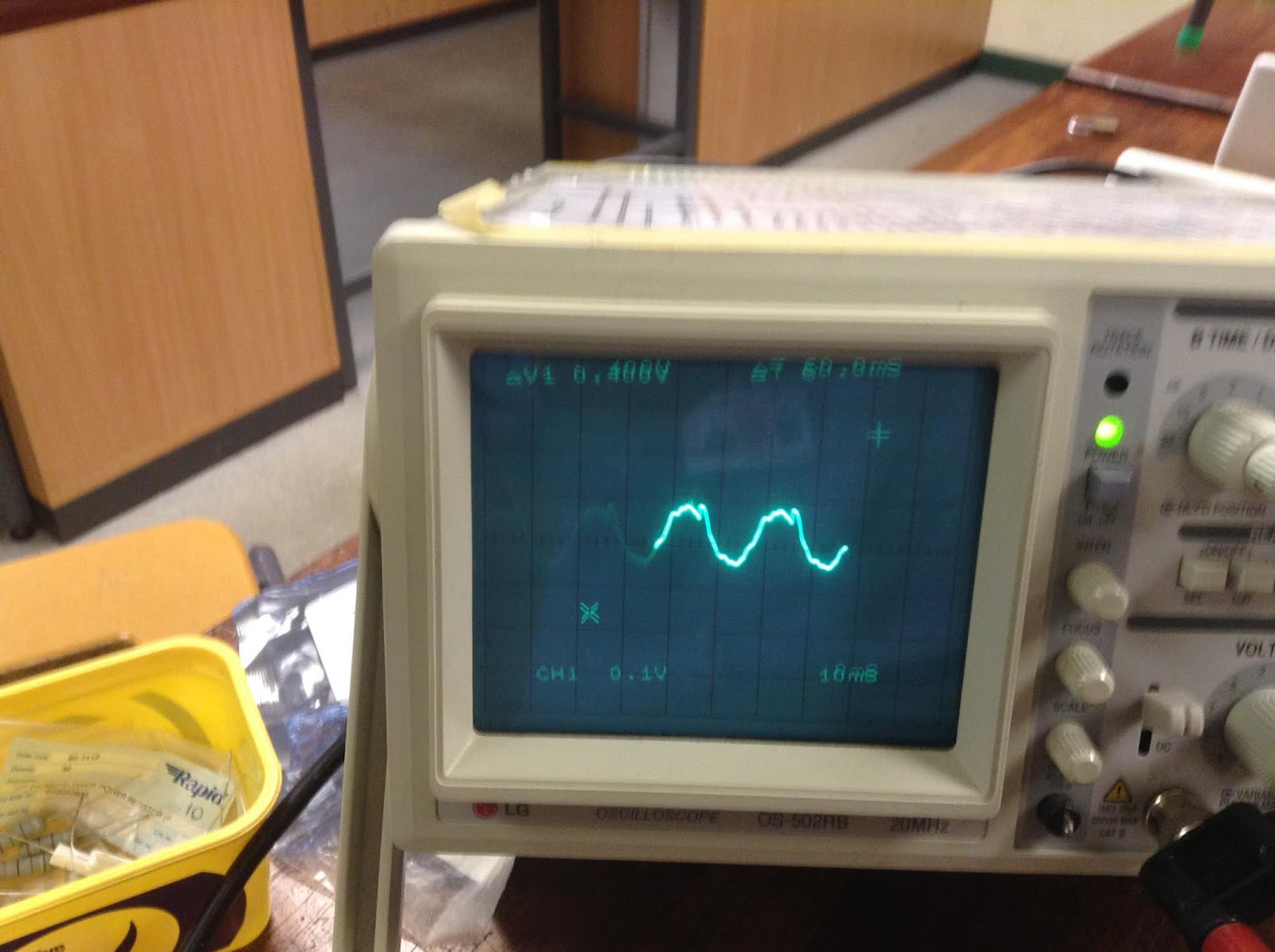
I set up an ac signal on an oscilloscope.
I then added a diode to the resistor.
It did seem to chop out the bottom of the signal although amplitude was reduced.
I then added a diode to the resistor.
It did seem to chop out the bottom of the signal although amplitude was reduced.
Sunday, 26 January 2020
An odd cloud inversion
The cloud inversion on Wednesday was an odd one because when we set off, there was no mist in the valleys. What usually happens is that on a clear night, radiation fog forms in the valleys as the air cools and falls below the temperature at which the air becomes saturated with water vapour. When the sun rises, it heats the upper layers of the atmosphere but the sun's rays can't reach the air in the valley to warm it. Hence warm air is above the cold air. Since it is warm air that rises, the thermal energy can't reach the lower layers and the cloud stays trapped in the valley. The cloud is "inverted". The odd thing on Wednesday was that the cloud began to fill in after I had got so warm in the sun that I had to take my layers off on the ascent. At that point, sunlight wasn't prevented from reaching the valley floor. So did the humidity rise? Perhaps there was more evaporation which increased the amount of water vapour in the air above the amount that the air could hold at that temperature.
Wednesday, 22 January 2020
Brocken Spectre at last
I've waited years but finally saw my Brocken Spectre with glory. It was a very small and distant example but I'm ecstatic. Here's how the spectre forms:
The glory is formed by refraction of sunlight in water droplets in the mist which is then sent back in my direction, a phenomenon called backscattering https://en.wikipedia.org/wiki/Brocken_spectre
Saturday, 18 January 2020
Other reasons that rocks move
I posted this week about rocks being carried long distances by ice. When I read The Pebbles on the Beach by Clarence Ellis last year, he mentioned that sometimes you can be fooled by rocks that were carried as ballast by ships and then dumped. This section of the Tyne near Wallsend was one such place. Thames dredgings mean that some of the rock could be chalk. I didn't go searching because of warnings about chemicals from old lead and tar works. In Physics, the extra mass carried in the bottom of the boat makes it harder to rock from side to side. It would give it a moment of inertia.
Friday, 17 January 2020
Excellent documentary about quantum entanglement
BBC 4 had a brilliant documentary on last night about quantum entanglement. https://www.bbc.co.uk/iplayer/episode/m000db95/einsteins-quantum-riddle Highly recommended. 4 weeks left to watch it.
Subscribe to:
Posts (Atom)