Saturday, 28 May 2022

Diffraction round a rock on Haweswater


Part of the old landscape was just above water level at Haweswater today. If you want to see which bit it was, you'll need to check the photographs here. The wind was driving plane waves towards it. The wavelength was roughly the size of the rock so the waves diffracted to fill in the area behind the rock that would have been in the "shadow".

Wednesday, 25 May 2022

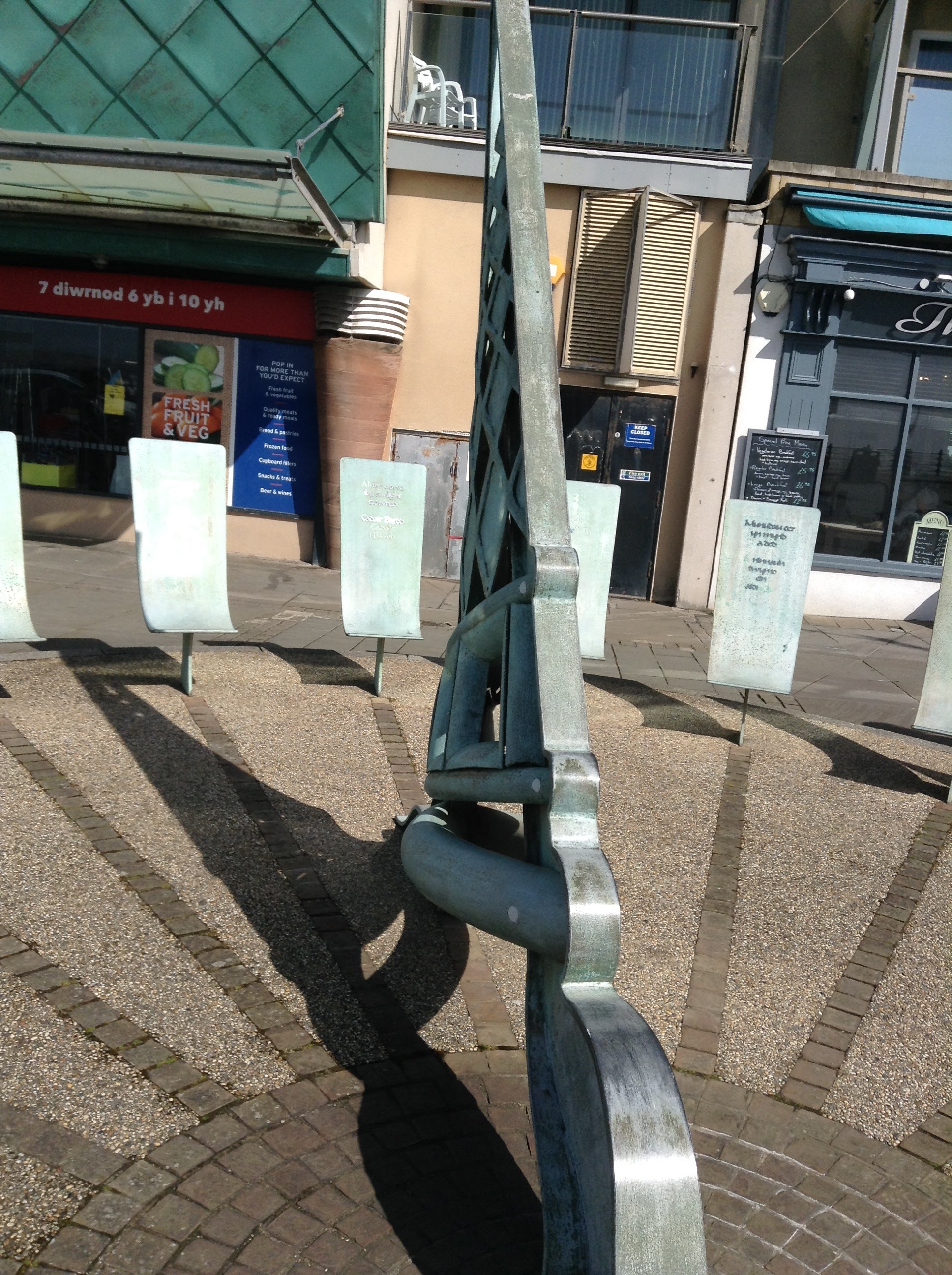
A sundial with seats in Porthcawl

 I'm always a sucker for a new sundial design. I really liked this one with seats in Porthcawl.


Wednesday, 18 May 2022

Could this be wad?

 We climbed up to the lowest level at the Seathwaite Graphite Mine - graphite being called wad in the old days.


These two rocks were lying around and seemed to be dark grey and crystalline. Could they be wad? The one on the left drew a nice line like a pencil. It had a measurable resistance with the contacts quite close that fluctuated between 500 and 1000 Ohms.

I had no pencil so back in Wigton I checked the resistance of a short pencil "lead"
So the pencil graphite has a much lower resistance but every other rock I've tested has a resistance so high that it can't be measured on the scale. It might well have been graphite.


Tuesday, 17 May 2022

This is what 1500 years looks like - Borrowdale Yews


I found a lovely guide to ageing trees from their girth here. Sadly I didn't measure the girth of the Borrowdale Yews but Internet cheating here says 7.56m at present but previously larger. This would tie in with the implications of the "poor ground and some exposure" section of the first document. Not as accurate but easier than counting tree rings in my opinion!

Monday, 16 May 2022

Finding the SHC of copper coins by a heat transfer method


We weighed ten 2p pieces. We got two polystyrene cups. We labelled them A and B. We put the coins into B. We measured 60 cubic centimetres of cold water into each and marked the level. We emptied the water and then added fresh boiling water from a kettle up to the mark. A is a control that tells us what the water temperature would be without the coins. When A reaches the highest temperature, take temperature in B as well. The difference is delta(theta) for the water. Calculate energy transferred to the coins from the water by 0.060kg x 4200 J/kgoC x delta(theta). This is the energy used to heat the coins up from room temperature, which also needs to be measured. Mass of coins in kg x unknown SHC x temp rise of coins = energy that went out of the water.

Sunday, 15 May 2022

Syenite at Scale Force (Red Pike)??


On page 8 of the Red Pike (Buttermere) chapter, Wainwright says that the subsoil next to Scale Force is coloured red due to syenite. I can find no up-to-date reference to syenite in England other than ones that seem to take it from Wainwright. It turns out that syenite is like granite but has much less quartz. see this There are other difference. The granite in Ennerdale is a redder granite. However, BGS seem to list several sites in Scotland, the nearest of which in the Nith Valley might be visible from my kitchen window! I did find Adam Sedgwick's The Geology of the Lake District on Google Books. This was published in 1853. On page 44 he calls the Ennerdale rock "syenite" as distinct from Eskdale Granite. This might well be Wainwright's source. I need to do more research on this.

Tuesday, 10 May 2022

Component of weight on a ploughing boulder

 I've posted about ploughing boulders before. This is a very good example on the slopes above Tray Dub in Langstrath.

The pole is 90cm long. The estimated dimensions of the boulder are 2m x 1m x 1m. Density of volcanic rock like this is 2500 kg per cubic metre so mass is estimated at 5000 kg. This is a steep slope to walk on; that usually means 30 degrees. Thus component of weight down the slope shown is 5000 x g x sin(30) = 25kN to 2sf. Most of the time friction is enough to hold it but some winters the freeze-thaw means friction must be less than this.