Wednesday, 25 July 2018
Hosepipe ban: projectile range
The hosepipe ban starts here in 10 days time. I tested the range of a projectile using the hose. In theory, a projectile goes the furthest horizontal distance when aimed at an angle of 45 degrees to the ground. See the top picture for this one. A much bigger angle doesn't fire it as far horizontally. That seems quite easy to understand. Less easy is that it won't go as far at a lower angle. This time the answer is that it doesn't have as far to fall so can't do along as much before it hits the ground.
Monday, 23 July 2018
How high are the stairs?
I tested the altimeter watch by taking readings at the bottom and the top of the Science Block stairs. A height of 7 metres sounds about right and gives a good level of precision for the mountains.
Sunday, 22 July 2018
3 dimensions in space at Lancaster University
I liked this corridor of fairy lights at Lancaster. Think of them as stars. Here it is clear that some are further away than others but notice that at the far end of the corridor, they all start to look the same distance away. With space, it is even unclear that any of the stars are close just be using the naked eye. Close stars can have their distance measured by parallax from one side of the Earth's orbit around the Sun to the other side.
Friday, 20 July 2018
Cutting off the electrical supply at Ben Wyvis
I found this under Ben Wyvis. I do see this apparatus quite often on similar lines in different parts of the country. It looks as though you hook the lever and pull. That moves the contacts apart.
Thursday, 19 July 2018
No coal at Ferrybridge Power Station
The space behind the bushes used to be a mountain of coal. I was amazed to notice that there was no coal at Ferrybridge power station anymore.
I looked up the new units. https://en.wikipedia.org/wiki/Ferrybridge_power_stations
Turns out that they have put in a multi-fuel power station. This includes biomass and waste. But it is much smaller. The old Ferrybridge was 2GW whilst this new plant is 68MW. That's 30x smaller.
I looked up the new units. https://en.wikipedia.org/wiki/Ferrybridge_power_stations
Turns out that they have put in a multi-fuel power station. This includes biomass and waste. But it is much smaller. The old Ferrybridge was 2GW whilst this new plant is 68MW. That's 30x smaller.
Wednesday, 18 July 2018
Lapse rate on Barrow
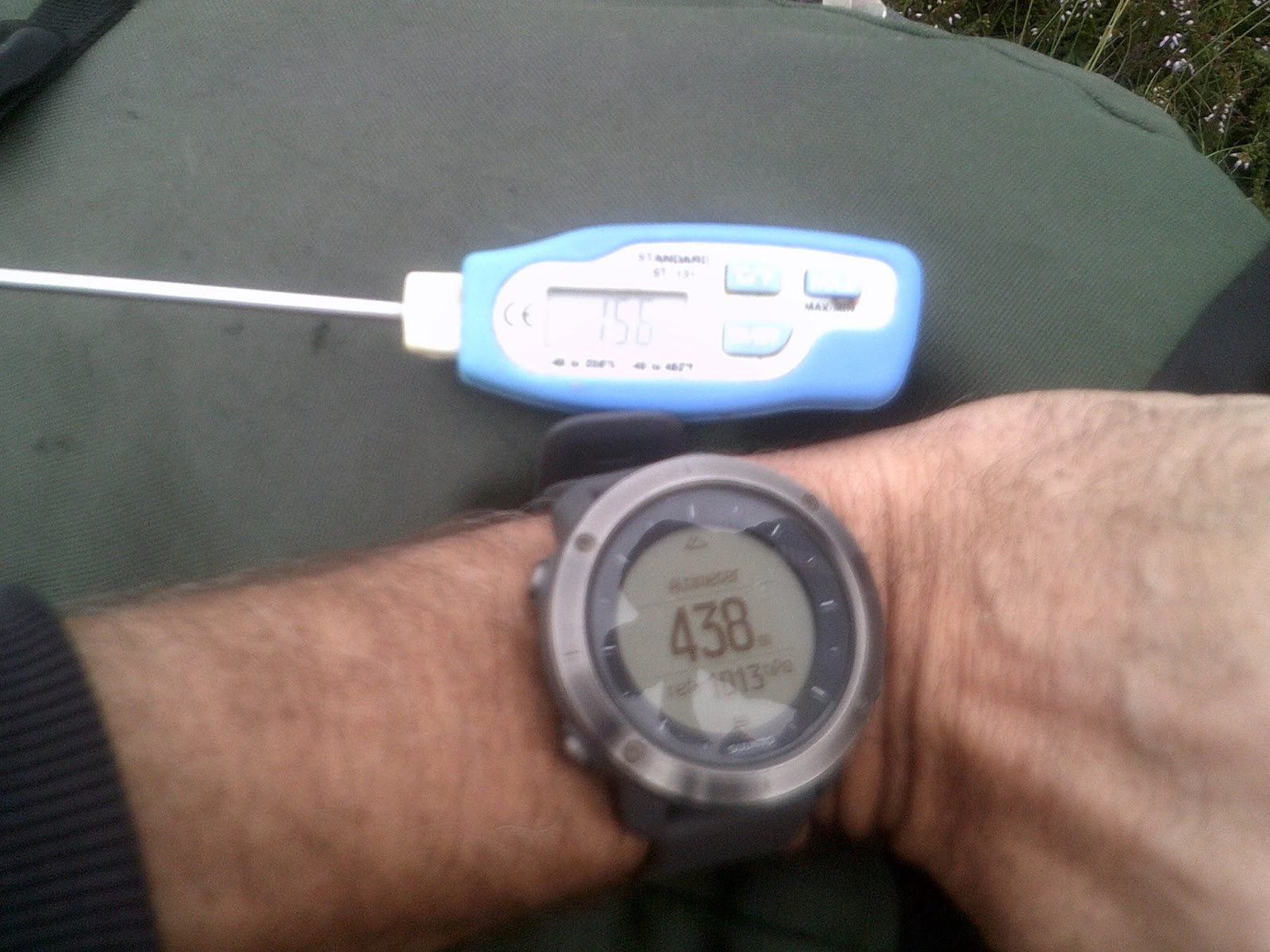
I climbed Barrow on Activities Day. I borrowed a watch with a height readout and measured the temperature at different heights. Here is some of the data
Here is a graph of all of the data:
The temperature falls with height. My data has a gradient of 0.0165 degrees Celsius fall per metre. That's 1.65 degrees Celsius per 100m or 16.5 degrees Celsius per km. The R squared value is low so the data is not that good. The third data point was a clear anomaly. This fall of temperature with height is called the lapse rate. It is explained here https://en.wikipedia.org/wiki/Lapse_rate I need to do more work on the thermodynamics theory but the value I should have got was 9.8 degrees Celsius per 1km so I have a percentage difference of nearly 70%. I knew we would be climbing quickly so that should have eliminated the time of day factor of solar heating and it was dull all morning.
Here is a graph of all of the data:
The temperature falls with height. My data has a gradient of 0.0165 degrees Celsius fall per metre. That's 1.65 degrees Celsius per 100m or 16.5 degrees Celsius per km. The R squared value is low so the data is not that good. The third data point was a clear anomaly. This fall of temperature with height is called the lapse rate. It is explained here https://en.wikipedia.org/wiki/Lapse_rate I need to do more work on the thermodynamics theory but the value I should have got was 9.8 degrees Celsius per 1km so I have a percentage difference of nearly 70%. I knew we would be climbing quickly so that should have eliminated the time of day factor of solar heating and it was dull all morning.
Monday, 16 July 2018
Well handle at Carlisle Castle
On this well handle, the length of the handle is 4x the radius of the drum around which the chain is wrapped. This means that the effort will be a quarter of the load. The density of water is 1 gram per cubic centimetre so a litre of water has a mass of 1kg and a weight of 10N. I might be able to lift 10kg so that I could pull 40kg of water up from the well.
Subscribe to:
Posts (Atom)