Tuesday, 30 April 2013

Green Fluorescent Protein

One of my friends had her class do some genetic engineering on bacteria. They used small loops of DNA called plasmids to insert genes from jellyfish into the bacteria. The genes let the bacteria make a protein that absorbs ultraviolet light and re-emit a greenish light. The bacteria were grown in agar plates. Here is a photograph of some of them taken in ultraviolet light.
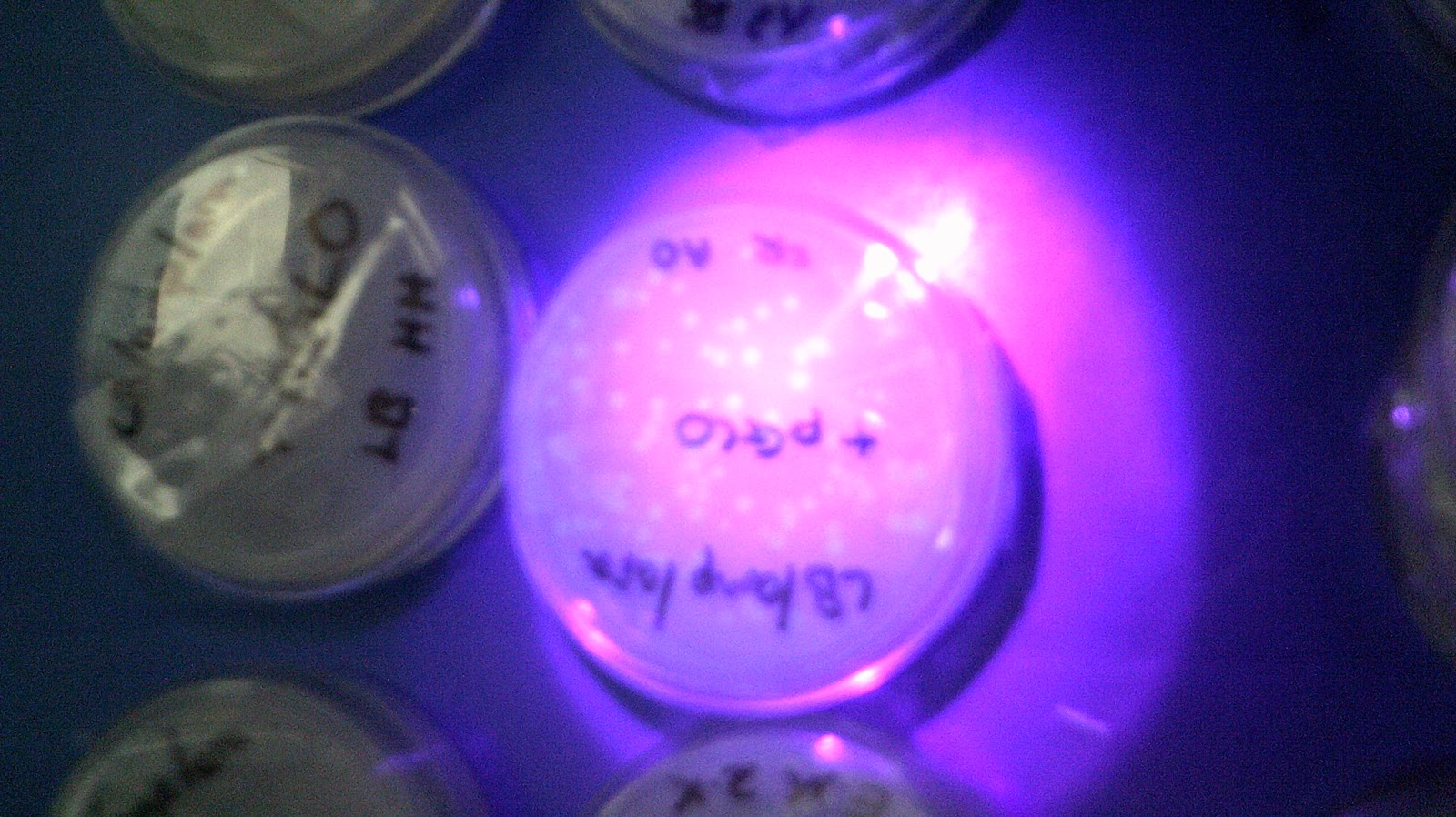
The physics of this trick with light is explained like this:
1. Remember that elecrons are found on different energy levels in an atom. This is the "electron orbits" model that is used in GCSE Chemistry.

 
2. In A Level Physics, we cut out a section of the energy levels and concentrate on that.

 
3. Here are the cut out energy levels. What happens now is that a photon of ultraviolet light comes in from the left. This high energy light provides energy to make the electron go up several levels. The electron could fall back all the way in one go and release a similar ultraviolet photon, or it could fall down the levels in stages as shown. These smaller falls release smaller amounts of energy, so the photons have a lower frequency. The main jump down releases these lower frequency green photons, so that's what we see. In other words, the electron arrangements in the Green Fluorescent Protein are such as to absorb invisible ultraviolet photons and mainly release visible green photons.

 
The other clever thing is that the Green Fluorescent Protein gene is bundled with genes that give the bacteria resistance to the antibiotic called ampicillin. There is also a gene that means that the Green Fluorescent Protein gene only works in the presence of a sugar called arabinose. So the photograph at the top is for a plate treated with ampicillin and arabinose.

Tuesday, 16 April 2013

Catamarans at Ravenglass

We spotted two catamarans in the harbour at Ravenglass. I don't know a lot about sailing but I do use these boats as an example of stability. The double hull increases the base area. A boat will capsize when the line of its weight acting vertically downwards goes down beyond the edge of the base area. The wider the base area, the harder it is for this to happen. We talk about there being a resultant moment - an overall turning force - acting. If the boat tips, so long as the weight continues to act within the base area, this resultant moment will pull the boat back to its original position. Single hull boats have a keel under the water to produce a moment that opposes the turning force of the wind acting on the sail. I did look on Wikipedia and found that the lack of keel on the catamarans means that there is less drag from the water. Catamarans can go faster. They are not likely to tip over sideways, for the reasons given above, but a very strong wind can tip them over forwards - they sort of go head-over-heels.


Wednesday, 10 April 2013

DIY sundial at Seascale

Seascale is a town with some Physics pedigree - you can see the Sellafield plant looming large behind it in the picture below. I did once hear that it had the highest average IQ of any town in the country in the 1950s due to the influx of Physicists sent to build the plant. I wonder if that's still true.

So I was really pleased to find a lovely bit of Physics near the station. It's a sundial where you act as the gnomon and your shadow points to the correct time. There are even two sets of numbers - one set for GMT and the other for British Summer Time. The clever bit is the block you stand on - different months mean different shadow positions. Note that the months near the solstice have thinner sections. Those near the equinox have wider sections because the day length changes fastest near the equinox. It claimed to be to within 15 mins, but I thought it was 30 minutes out. Whatever - any equipment that even tries to state its uncertainty gets my vote!


Random bloke tries out the sundial.
The all important month block.


Saturday, 6 April 2013

Diffuse sky radiation

Thinking further after yesterday's post, the obvious thought struck me - there's still light on a cloudy day. The evidence is in the picture above. (We rang the bells in the Town Hall tower!) I remembered that this is due to SCATTERING. I didn't study this in my Engineering degree but have just learned a lot by Googling it. Clouds are an example of Mie Scattering - the water droplets are large compared to the wavelengths of light so all wavelengths have an equal chance of being scattered. This mix of all wavelengths gives clouds their white colour. However, the gas molecules in the air are much smaller than the wavelength of light, so they cause Rayleigh Scattering. Here the smaller the wavelength, the more the scattering. Blue has a small wavelength and so is scattered a lot by the air molecules, hence the sky looks blue. The scattered light reaching us on the surface of the Earth is then called diffuse sky radiation. So it started in one place - the Sun - but the light was then scattered and appears to be coming down from all over the sky.

This was the view of Berwick from our pitch on the caravan park. It looks like a medieval Italian town with the red roofs and its Elizebethan walls. Note the blue sky! But it takes me back to Dan's big question last month: "Violet has a shorter wavelength than blue, so it must be scattered more. Why isn't the sky violet?" Google revealed that the answer is that it might be but that the physiology of your eye means that the cone cells detect blue wavelenghts far better than violet.
 

Friday, 5 April 2013

Light in Berwick

We spent the week in Berwick upon Tweed, the most northerly town in England. The caravan park was on a hill above the estuary, looking back across to the town and out to sea. I began to notice that the sea looked different shades of blue, depending on which direction you looked relative to the Sun. That got me thinking about how we see things. The picture above is Berwick by night. We only see the luminous objects that make light, and a few that reflect light ( you might make out the arches of the railway viaduct). Below is a picture from the oldest bridge, looking into the Sun. It is obvious that we see the river because it reflects sunlight. The light patch at the bottom of the picture is a true reflection of the Sun in the "angle of incidence = angle of relection" sense, but I'm still thinking about the bright patch at the top of the picture. It must be a reflection of the Sun, but the angles don't quite work...

This picture of the viaduct is taken with the Sun behind me. You can see that it reflects sunlight back at us directly because it looks bright, and that sunlight reflects from it onto the water and up to our eyes. So to some extent, the river is lit up by reflections from elsewhere. It's just that, when I stop to think about it, not all of the angles seem to make sense.
 

Tuesday, 19 February 2013

The Skeptical Environmentalist


This year I have decided to get to the bottom of some controversial issues. I want to know what the scientific evidence is concerning Global Warming. Many Cumbrians seem convinced that there is no such thing. A related issue is that of the switch to renewable energy sources. Many people round here do not like windfarms. Two or three years ago, people round here who are opposed to windfarms routinely said to me that they favoured nuclear power as the "good for the environment" option. I wonder what they are thinking now about the debate concerning the burial of nuclear waste. Clearly, nuclear power creates radioactive waste so something needs doing with it. I think that as a Physics teacher, I should have researched all opinions, sorted out the scientific evidence and decided how I read that evidence. I should be able to give some sort of confidently expressed researched opinion as a Physics professional. So I'm reading. I have started by borrowing the book in the photograph from Cumbria Libraries. Bjorn Lomborg is a Professor of Statistics from Denmark. A decade ago, he went over all of the data he could find about the state of the environment. He wanted to see if things were as bad as they say. He concludes that the environment is actually getting better. This is very controversial. But if even half of his claims are true, then we should be OK. Wikipedia reckons that Jeremy Clarkson likes this book. Those who know me will realise that I'm worried by that! However, I can't fault his logic so far. It is a fat book: 350 pages of analysis and 150 pages of references. He has a great writing style. It's an excellent book to start with. I'm keeping an open mind. I will have finished it by next week so you can request it from your local library in Cumbria.

Sunday, 27 January 2013

Frozen water butt problems


The other winter, the spell of freezing weather that went on for weeks caused a problem with our water butt. Water freezes from the top down - that's the reason life survived on Earth as it could survive under the ice sheets on frozen oceans. Here, the problem is that it also explands as it freezes. The stuff that freezes first at the top doesn't expand upwards anticipating the lack of space. This means that the stuff that freezes last at the bottom has no space into which to expand. It thus expands downwards, pushing out the flat plastic bottom into a rounded shape. The water butt was free to wobble on its round bottom and it fell over. Water is H2O. The hydrogen atoms in one H2O molecule are attracted to the oxygen atom in the next water molecule. This is called hydrogen bonding. At ordinary temperatures, the heat energy is enough to wobble the molecules out of fixed bonding patterns. But as water freezes, the molecules can form fixed hydrogen bonds, making the H2O into a solid. These fixed bonds give the water a rigid molecular structure, like scaffolding, and this opens up gaps, pushing the molecules apart. Google it for a more scientific explanation and diagrams!