Monday, 7 October 2013
Smarter Every Day
If you haven't come across this Youtube video blog http://www.youtube.com/user/destinws2 it's brilliant - you might not like the cat one, though, so try to find the coloured lasers in Dutch.

Sunday, 6 October 2013
Einstein isn't the only physicist

We found this lovely piece of street art under the bridge over the Thames on the southern by-pass in Oxford. Einstein is such an iconic figure - but I like the phrase "Einstein isn't the only physicist" that I got from a poster in my laboratory. One of the most important living physicist is Leonard Susskind who was a founder of String Theory. He has done a brilliant service in giving public lectures at Stanford University and posting them on the Internet for us all to watch. I have started watching the ones on Einstein's General Theory of Relativity. They are all nearly 2 hours long so I'm going to watch them in bits: http://theoreticalminimum.com/courses
Saturday, 5 October 2013
Faraday in Cumbria
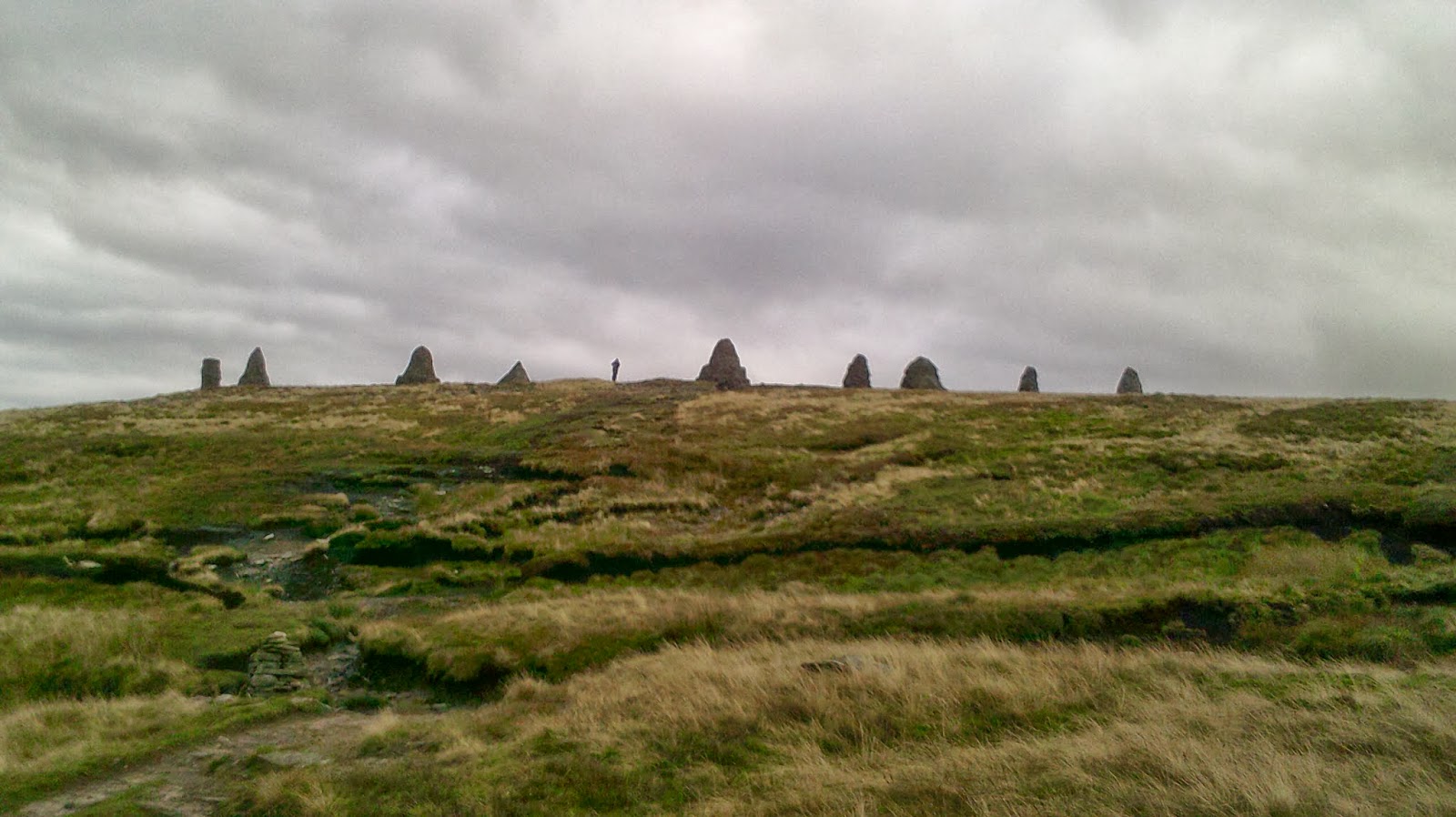
Today we went up the iconic Nine Standards Rigg at Kirkby Stephen. There were amazing views along the Pennines, over into the Lake District and across to Teeside. Near the summit, we were walking alongside Faraday Gill. Northerners will know that a gill is a stream. Here is a picture of the useless bridge over Faraday Gill.

What got me excited is that Faraday is such an unusual name. Michael Faraday was one of the most amazing physicists ever, having discovered so much about electromagnetism. He was a great experimenter: I have a lot of respect for experimental physicists. Looking up the connection, Wikipedia informs me that there is a road Kirkby Stephen named after Michael Faraday's uncle who traded in the town. Michael Faraday's father was a blacksmith in a hamlet very close to Kirkby Stephen but moved to London before Michael Faraday was born. The naming of the gill must surely have something to do with the family. Another Cumbrian Physics connection. Hurrah!
Below is a picture of the shale beds uncovered by Faraday Gill. How much shale gas is locked up in here??

Friday, 4 October 2013
A detail I hadn't spotted

I posted this picture of a transformer in August. It is front of the iconic Scottish mountain, Buchaille Etive Mor. I was looking at it again today and I noticed that the insulators holding the wires onto the wooden frame are not equal lengths. It has finally dawned on me that the higher the voltage, the more insulators are needed. Logic would suggest that the transformer is stepping down the voltage from right to left. The Kingshouse Hotel is out of shot on the left. If the insulators show that the voltage is 2/3 the size on the left, 2/3 of 11kV is 7300V. I think that's a bit high. I wonder how they choose the number of insulators? My calculations in a post on the subject in September suggests that they use a large safety factor.
Thursday, 3 October 2013
Street lights
One of the things about city life is the orange glow in the night sky from the large number of street lights. In Nottingham I could never see the Milky Way because of the light pollution. In Wigton it is possible to pick it out. The orange street lights are sodium. The metal is vaporised and placed in a glass bulb between two electrodes. A beam of electrons then courses through the vapour. When an electron hits a sodium atom, it knocks one of the electrons in that atom up several energy levels. As that excited electron falls back down, it emits a photon of light. The frequency (colour) of the photons is fixed by the size of the energy level jump. As these are unique to a particular element, sodium has photons of a different frequency to the mercury street lamps. In sodium this adds up to an orange glow.


Wednesday, 2 October 2013
Newton in suburbia

Here's what it looks like in the suburbs of a big city. But I was thinking about the forces under a car's tyres. Typically, I draw friction as a backwards force under the wheels of a car - a counter force to its motion. But think - the car engine provides torque to turn the wheels. The contact between the rubber and the road means that the tyre tries to push the road backwards. By Newton's Third Law the road must try to push the car forward. The road is heavier and it doesn't move. So you can argue that it is friction that is the force pushing the car forward. Try this Durham University page as an example: http://www.dur.ac.uk/r.g.bower/public_html_old/PoM/pom/node16.html
Tuesday, 1 October 2013
Flying school?

The above picture shows a classroom at a school in Nottingham - yes, it 's the aeroplane. The Headteacher had the plane brought over from Liverpool Airport and refitted for lessons! It reminds me that there is a controversy in Physics about the way in which planes fly. I was taught the Bernoulli Effect explanation which focuses on the aerofoil shape of the wing - basically flat along the bottom and curved over the top. You then say that the wing splits the air. Some goes over the top, some goes over the bottom but the air joins up again at the back. It has to go further over the curved top so this means it has to go faster to keep its appointment to rejoin the air from the bottom at the back of the wing. Faster air has molecules that are more widely spread and thus at lower pressure. Higher pressure below the wing and lower pressure above: the wing is pushed up. Now it seems more acceptable to use Newton's Third Law as we did with the rowing boat last week. The wing is angled as it goes through the air to push air downwards. The air has mass (inertia) but obviously less than water. However, it means that the air pushes back up on the wing. There's the lift. If you search the Internet, you'll find that people get quite passionate about this debate. Here's one example: http://amasci.com/wing/airfoil.html
Incidentally, viewers in rural areas like Wigton might take note of the picture below. Even schools in nicer parts of the city have fences around them to keep you out of the grounds when school is closed.

Subscribe to:
Posts (Atom)