Wednesday, 10 September 2014
Sea breeze at Allonby
I was at Allonby on a hot afternoon. Look at the flags. They are blowing away from the sea. The wind always comes off the sea and onto the land on a hot day. The land has a lower specific heat capacity than the sea. It is also duller. It absorbs more infra-red heat radiation and the same heat energy gets it to reach a higher temperature sooner. Thus the air above the land reaches a higher temperature than the air above the sea. Air above the land expands, becomes less dense and floats up. It cools at height, shrinks, becomes more dense and sinks over the sea. At ground level it completes the loop by moving back in from the sea to the land. The on-shore breeze is part of a convection cycle.
Make an observation #2
Here's a view on the A6 at Shap summit. Make an observation or ask a sensible question about something to do with Physics.
Sunday, 7 September 2014
Paraglider thermals on Scafell
We spotted these paragliders whilst climbing Scafell. The highest of them must have reached over 1000m above sea level. The sun was hot and the infra-red radiation is absorbed by the ground. This heats the air that is in contact with the ground. This air expands and becomes less dense. Being less dense, it floats upwards. It is this upward current of warm, less dense air that is called a thermal. The paraglider spirals to stay in that column of air and is taken up and up. I'm not sure how wide the column would be. However, the force must be enough to lift the person and the parachute.
Wednesday, 3 September 2014
Make an observation #1
Look at this picture carefully. Either make an observation of something that you notice that might be explained by Physics (you don't have to explain it) or ask a question that is to do with Physics based on an observation.
Lower Sixth Challenge Question #1
There is a chain walk along the bottom of the cliffs at Elie in Fife, near St Andrews. They have hung chains over cliffs so that you can hang off them to climb up and down. The safety information says that the bolts from which the chains hang are tested every year to loads of 5kN. Let's assume that the chains are made of stainless steel which has a density of around 8000kg for every cubic metre of volume. Look at the chain in the top picture. How close am I to the safety limit if I hang off the chain?
Tuesday, 2 September 2014
Preparing for Lower Sixth Physics #19: Precision
The sign says 7 3/4 miles to Sebergham. Ah, fractions! We don't usually use them in Physics. We like decimals because a decimal will tell you the PRECISION of the measurement. Let's go with 7 3/4 metres because it breaks down more easily than it would in miles. 7.75 m would mean it was measured to the nearest centimetre. 7.750 m might seem the same but it actually shows that I measured to the nearest millimetre, which is clearly more precise. So please start using decimal fractions to show the correct precision of any measurement.
Monday, 1 September 2014
Altimeter calibration on Whiteless Pike
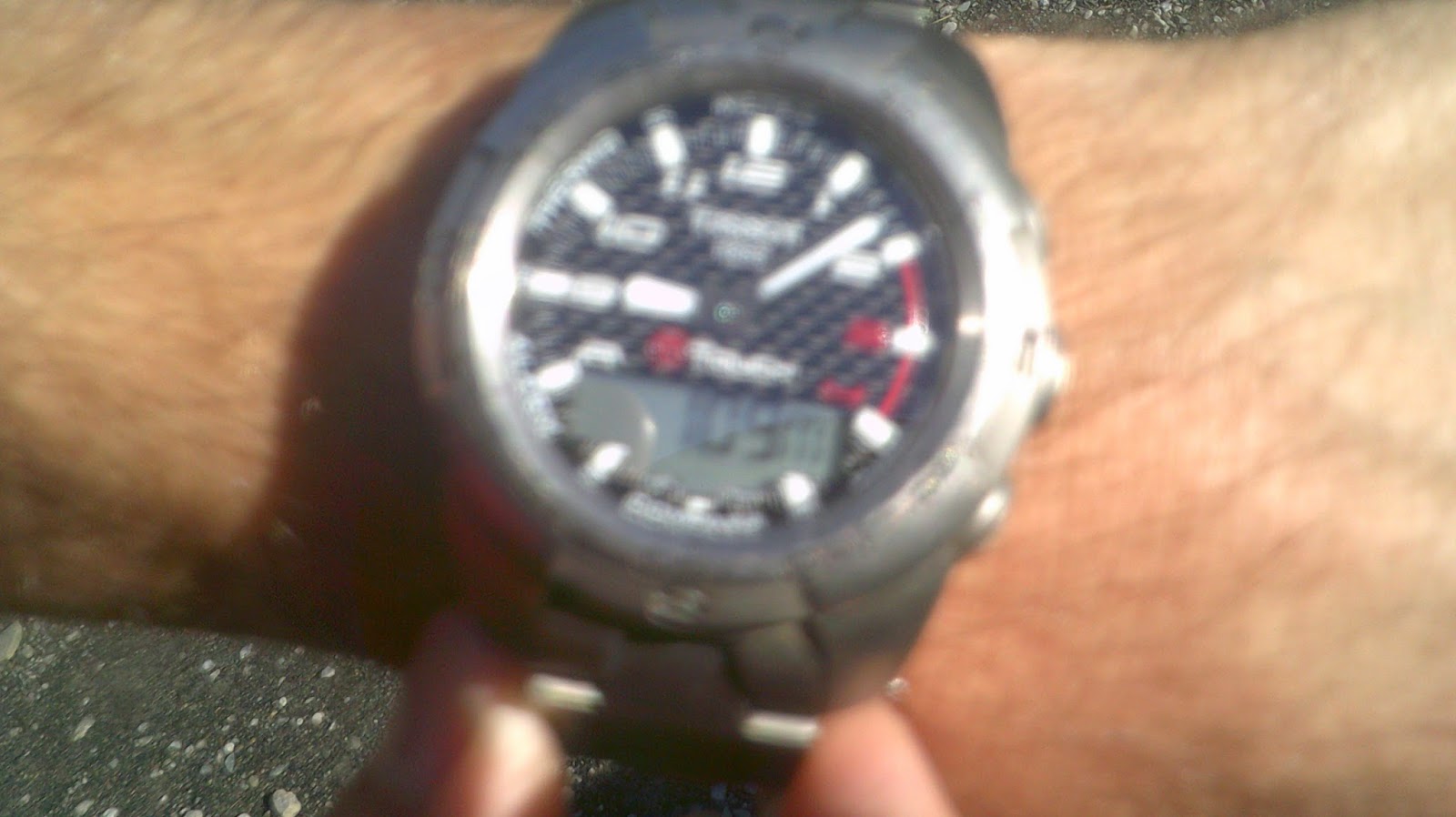
After the systematic error when we went to the Secret Cave, this time we remembered to adjust the altimeter in the car park in Buttermere before we set off. The car park was close to the 110m contour. Then we climbed Whiteless Pike, which is 660m tall. The altimeter said 650m on the top, which is not bad. Looking at the map now, I suspect we misread the start height and were out by about 10m before we set off. Bad calibration leads to systematic error later on.
Subscribe to:
Posts (Atom)