Tuesday, 23 August 2016
Calibrating the step counter in Martindale
We have a new step counter. You have to tell it your step length so it can tell you how far you have gone. The problem with hills is that step length is so variable. I did over 31000 steps and it told me that I had done 22km. On the map we'd done 17km. We will need to keep tweaking the step length input until we get the right distance covered.
Monday, 22 August 2016
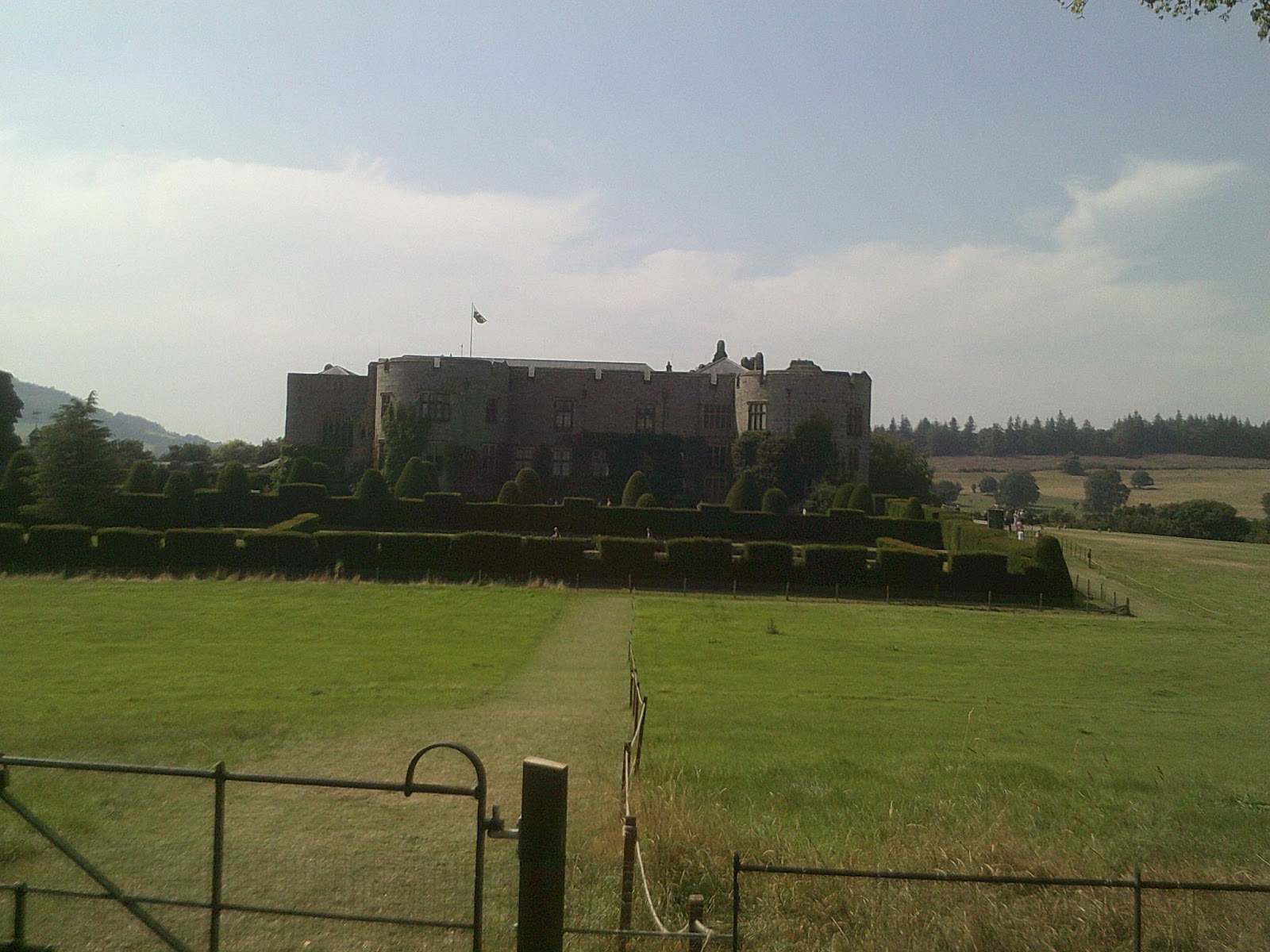
Monitoring the light level at Chirk Castle
This is Chirk Castle, just over the border into Wales. It is owned by the National Trust. I spotted the "Light Monitoring" on a piece of furniture in the first room. Photons of light can provide enough energy to change the chemicals in some materials over time and ruin them. This is a problem in preservation. So they put blue material into a card. The material you can see is exposed to the light but there is more under the cardboard that acts as a control. The difference between the two is read by a machine. Wonderfully simple and low-tech: Physics applied in conservation.
Sunday, 21 August 2016
Earthed electricity pylon
Having figured out that the top wire is the Earth wire, I was wondering how it was wired to the ground. Did it go through the metal framework? I found this example at Chester Services on the M56. If you look carefully at the point of the pylon, there is a junction taking the wire down. Then there are pegs down the left hand side that carry a wire down to the ground. There was the same on the far right.
Saturday, 20 August 2016
Tiny rainbow in Grasmere
This tiny rainbow caught our attention. Technically, rainbows are a full circle based around what is called the anti-solar point. You get to the anti-solar point by following a line from the Sun down through you and into the Earth beneath. Keep going until you are as far below ground as the Sun appears to be above ground. So in summer, when the Sun is higher in the sky, the anti-solar point will be deeper underground and the section of a rainbow visible above ground will be smaller. Even so, I was surprised by how small this was! It was only about 10am BST so if we had waited 3 hours until noon GMT then presumably it would have been even smaller! Thanks to Paul for taking the pictures.
Friday, 19 August 2016
More tensioning weights for railway cables
Spotted from the train on the way to Cologne. 13 discs. Say diameter 15 cm and depth 4cm. Volume would be about 700 cubic cm. A search suggested a density of 2.4 grams per cubic centimetre for hardened concrete. That means each block would be 1.7 kg. The total stack would be 22 kg. That would be a force of about 200N. Is that enough? I need to look at the size of the wires next time. I think the blocks are concrete. If they were steel, the force would be nearly 4 times bigger.
Wednesday, 17 August 2016
Light sensors on the street lights - first decent storm of the summer
We had the first big thunderstorm of the summer through Wigton at breakfast time a couple of weeks ago. The streetlights came on. They must be fitted with light sensors. These can't be simple Light Dependent Resistors because these use energy from photons to promote electrons from the valence band to the conduction band. More electrons in the conduction band means higher current so we say that the resistance is lower. (I think this is a bit of a cheat because it doesn't mean that the lattice ions are vibrating any less). So in the dark the resistance will be higher. Less current would not put the light on. So it must make use of electronics. A NOT gate would flip the input.
Tuesday, 16 August 2016
Two earths on the way to Utrecht
I was interested in this design of pylon in Holland. There are two top Earth wires - they carry no insulators. I wonder what the advantage is.
Subscribe to:
Posts (Atom)