Tuesday, 18 October 2016

1 lux in the moonlight

Here's the full moon reflecting off a white wall. The camera is not as good a light collector as my eye. I could even see my shadow on the ground, which would not come out in a photograph. A full Moon on a clear night gives up to 1 lux. Further to yesterday's post about the perigee Moon looking bigger, I suppose the simplest thing to do with the apparent size is to square the angle subtended at the eye to give some sort of angular area subtended. At perigee that would be 9.59 milliradians to be squared giving 92.0. At apogee it would be 8.57 milliradians squared giving 73.4. The perigee Moon should look 92.0/73.4 = 1.25 x bigger or 25% bigger. I'm getting closer to the 30% figure commonly given.

Monday, 17 October 2016

Hunter's Moon and supermoon

The Moon was unearthly orange when we were driving home at 7pm last night so I looked to see if we were missing an eclipse. Articles called it a Hunter's Moon, though that seems to be a folklore name for a full Moon in October, perhaps when the poachers were out. It turns out it was also a supermoon. This is not a scientific term since it originated with an astrologer not an astronomer, The Moon does not go on a perfectly circular orbit around the Earth. It follows an ellipse. A supermoon is when it is at its nearest point, which is more accurately called the perigee. That's about 362600km away. By contrast, at its most distant or apogee, it is at about 405400km which is 12% further. They talk about how big the Moon looks. This will be connected to the angle subtended at your eye. In radians, that is the diameter of the Moon divided by the distance to the Moon. For perigee, the angle subtended is 0.00959 rad and for apogee its 0.00857 rad by doing the calculation using the radius of the Moon as 1738km. The apogee angle is 0.88 x the perigee angle so the perigee angle is 12% bigger. Squaring to give area would leave the Moon looking 23% bigger at perigee. I read figures that say 30%.

Saturday, 15 October 2016

50 lux in the kitchen

I think the main kitchen lights are bright. I didn't need the flash on the camera to take this picture. But the solar powered flower toy wasn't working so the light intensity cannot have been high. Having posted about the lux light scale recently, I looked up the brightness of internal house lights - it's about 50 lux.

Friday, 14 October 2016

Ben Nevis caldera part 1

Last Christmas we went up Mount Teide on Tenerife. Many years ago, the then top of the volcano collapsed inwards creating a vast bowl, It's a pretty flat circle surrounded by cliffs. This is called a caldera.Then we went to Ben Nevis and found this:

So the same thing happened to Ben Nevis 410 million years ago. This is going to take some thinking about. But the view below must once have looked like the top picture from Tenerife!

Thursday, 13 October 2016

Dutch wind farms


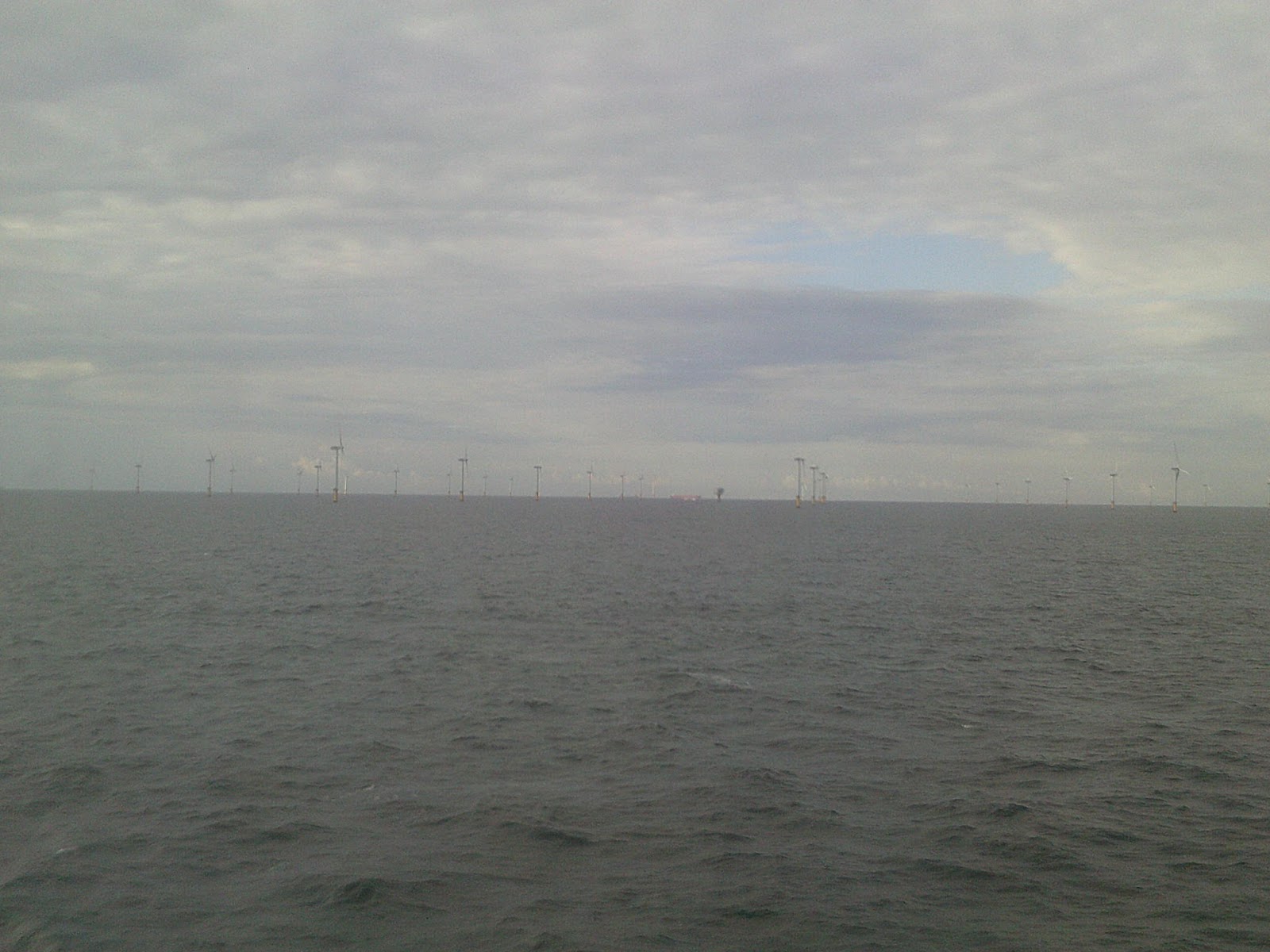
I took these pictures on the way into IJmuiden on the ferry from Newcastle. They are probably the Princess Amalia wind farm although there are two separate wind farms in that section. Princess Amalia has a name plate capacity of 120MW so it is not as big as Robin Rigg. I wasn't expecting that. I thought continental wind power would be bigger. Robin Rigg claims to supply 117,000 households. The population of Cumbria is 500,000 so that might well be half of Cumbria. This Dutch wind farm might do 100,000 households.

Wednesday, 12 October 2016

Robin Rigg wind farm


The offshore wind farm at Robin Rigg is a prominent feature in the view from north-west Cumbria. I've looked up its statistics https://en.wikipedia.org/wiki/List_of_offshore_wind_farms_in_the_United_Kingdom   180MW compares to a peak UK usage of about 50 000 MW so it provides less than 1% of peak power. It seems to be a medium-sized offshore wind farm - the ones near Barrow are much bigger in total. The West Duddon station provides twice the peak power but at four times the installation cost. But Wharrels Hill, the prominent wind farm near Bothel is only 10MW so this is huge!

Tuesday, 11 October 2016

Craters on the Moon


I decided it was time for me to stop ignoring the Moon. I never could get excited about the Moon when I was young but I have recently discovered that all of the features are named. This article explains who named the craters http://moonphases.info/how-the-lunar-craters-got-their-names.html Galileo coined the word "crater" from a Greek word for bowl because he was the first to see them as they are by looking at them through a telescope. I went out last night to take this photograph through my telescope. These northern craters were named by Giovanni Battista Riccioli a few years later after famous astronomers from the past. I'll have to find out what astronomy was done by Plato!