Wednesday, 11 July 2018

Flow rate: estimating the numbers at the Oxford Race for Life

We were supporting at the Race for Life and were debating the number of participants. I timed a minute and counted the number of rows of runners who went past. Each row was roughly 5 runners wide. About 60 rows went past - so about one per second. That's 300 runners a minute. It went on for 10 minutes which means 3000 runners. The next day the Oxford Mail was saying "more than 2500" so it turned out to be a reasonable method.

Thursday, 5 July 2018

Echo chamber: Carlisle Castle dungeon


It was a lot cooler down in the dungeon. Sound took up to 2 seconds to die away. The reverberation was incredible. Sound must repeatedly bounce from wall to wall with little attenuation each time due to the hard surface. We thought that perhaps the arched roof helped to focus sound waves. I estimated height and width of about 6 m. At 330 m/s the sound would take about 0.02 seconds to go from one side the other so there could be up to 100 reflections before it dies away. I tried humming at different frequencies. There was definitely a resonance at a low frequency. The lowest a human can hear is about 20 Hz. The fundamental mode (1st harmonic) for a 6m chamber would have a wavelength of 12 m. So frequency = wave speed/wavelength = 330/12 = 27.5 Hz. Sounds feasible.

Wednesday, 4 July 2018

Heatwave part 1: railway speed restrictions

We've been enjoying the most amazing spell of weather for the far north of England but trains in the Carlisle area have been experiencing speed restrictions because the line have been warped by the heat. I have always understood that they leave expansion gaps between rails to cope with the expansion of metal in warm weather. This is why trains traditionally go clickety-clack. But it appears that there has been some warping between the joints, hence the speed restrictions. But they have also been painting the rails white in places to reduce the absorption of infra-red from the Sun. I found https://www.networkrail.co.uk/running-the-railway/looking-after-the-railway/delays-explained/buckled-rail/ This suggests that modern rails are made from different bits welded together. I'm wondering if that means the expansions work against each other. Needs some research.

Monday, 2 July 2018

Thinking about the green flash


It has been a brilliant week for sunsets. As light from the Sun passes into and through the atmosphere, it slows down slightly and is bent. This bending depends on the optical density of the air (its refractive index) and varies with the density of the air layers. We could draw a diagram in which light from the Sun was unbent and traveled straight. Then we could work out when it was below the horizon and we could no longer see it. However, because of refraction and the bending, straight line rules don't work and the top of the Sun would still just be visible. This hair-splitting depends on how you choose to define "over the horizon". So in my last picture, I can argue that the Sun is actually over the horizon. At this last point, the refraction splits the light into colours as does a prism. The last colour to be seen should be blue but that is selectively scattered leaving the last colour as a green flash in perfect conditions. I thought I caught a glimpse. I am finding the explanations hard going so expect more when I've done more thinking.

Sunday, 1 July 2018

Melting point of bitumen - road in Wasdale


The asphalt has melted on the roads in Cumbria! It's wonderful that the weather is so hot. They have sent the salt gritters out to spread road stone on the bitumen. Bitumen has a high melting point because it is made of long, heavy molecules. I think that this means that there can be more intermolecular forces to hold the molecules together in a solid formation. More joins to separate means more themral energy needed so higher temperature. The explanations usually focus on higher boiling points. I haven't seen one that explains melting points.

Friday, 29 June 2018

Refraction in the fish tank

Look at how this fish tank at Maryport Aquarium appears to narrow very quickly, far more quickly than perspective would allow. I've been working on a ray diagram:
Light from each end has to bend to reach the same eye, meaning for the angles of refraction that r2>r1. This means that the ray with angle r2 is showing you a piece of the back wall that is further back than the distance between the two normal lines on the front wall. I added the dotted blue lines with the idea that the brain can't cope with light bending and makes it so that what we see is as if the light had gone straight. This accentuates the effect described above.

Thursday, 28 June 2018

Sundog at sunset
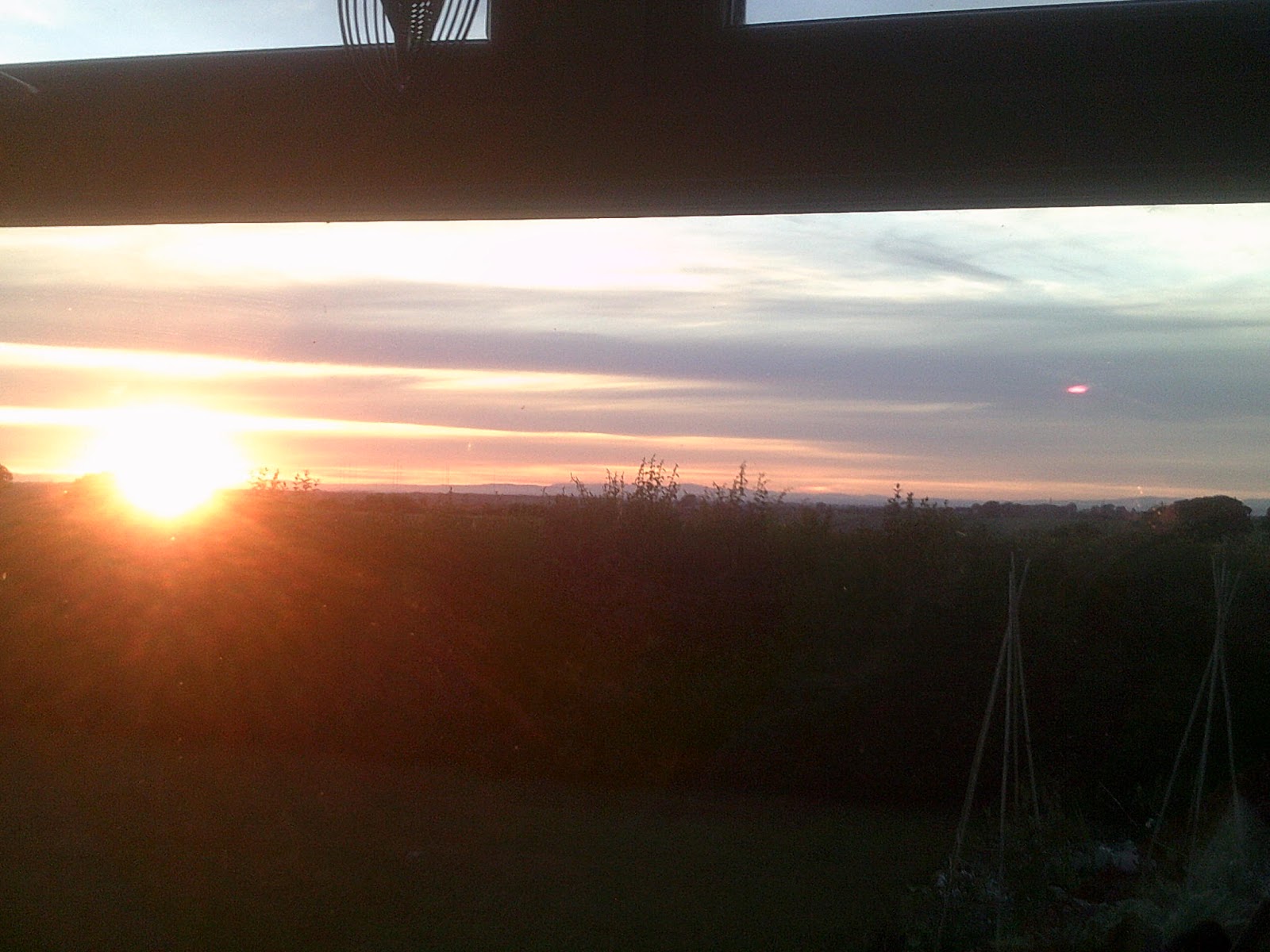
Two days ago at sunset I spotted a sundog on the horizon. In the photograph above it is not the prominent bright spot in the middle of the grey cloud - that's a reflection. It's level with the Sun and one third of the way in from the right just above the hedge. There have been a lot of sundogs this year but with this one, it struck me that it seemed an awfully long way from the Sun, more so than usual. Celestial distances seem exaggerated close to the horizon. For example, the Moon seems much bigger when low over the horizon. So I measured the angle as shown below. Thumb to little finger is about 20 degrees. The sundog is always 22 degrees. Below the sundog is just past my little finger, so it's right.