Friday, 7 October 2022

Rolling thunder


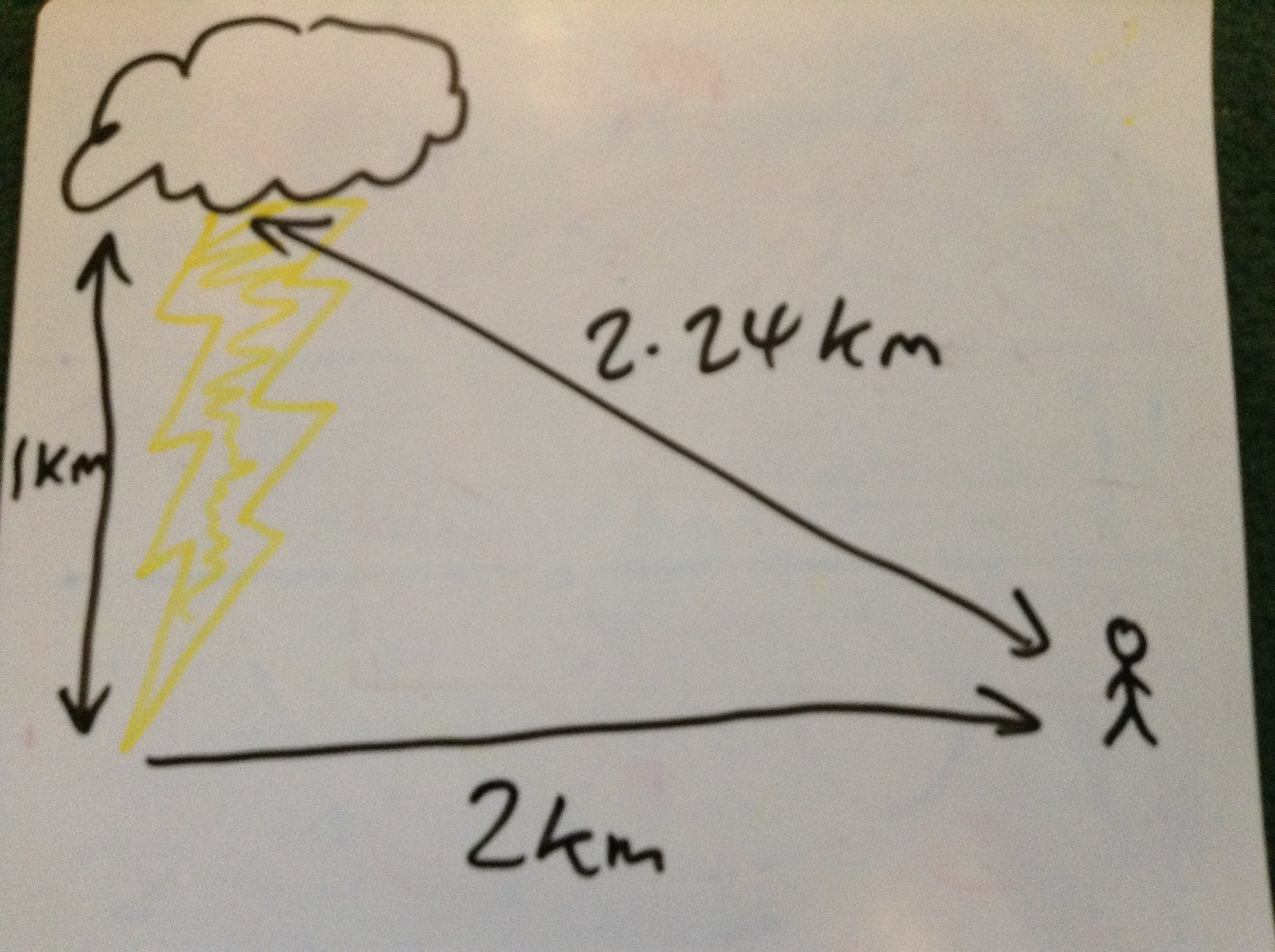
Once again, Helen Czerski's book Storm in a Teacup has got me thinking about simple ideas that I'd never considered. She tackles the idea of why thunder is often a prolonged rolling sound. The answer is to do with the distance away. The sound is made from all points on the tall discharge but because sound travels so much slower than light and the distances are big enough to make a difference, the sound from the top of the discharge arrives later than the sound from the bottom. In the example above, if sound travels at 330m/s, it will take 6.1 seconds for the sound to arrive. From the top it would take 6.8 seconds. That is a noticeable difference. However, I think that the further away you get the less the difference will be. Perhaps I'm not understanding this correctly.

Thursday, 6 October 2022

Gaia at Greenbelt - why is it a blue planet?

The Gaia installation was at the Greenbelt Festival and was especially effective when illuminated at night.


They call us the blue planet. I have been very interested in Helen Czerski's brilliantly clear explanation of why water that comes out of a tap colourless actually looks blue when in the sea. It's in her book Storm in a Teacup. She explains that light entering the water is bounced around, heading mainly downwards but that eventually some is reflected back up out of the water and that is what we see. She explains that water molecules are able to absorb the other colours if the water is deep enough but not blue, so that is what we see. My next thing is to try to find out why water prefers to absorb red and not blue.


Wednesday, 5 October 2022

Looking for a parallel road above Mitchellslacks


Parallel roads are the old shorelines of glacial lakes, relics of the Ice Ages. I've never been to Glen Roy so I was excited to read in Ronald Turnbull's Cicerone guide to the Southern Uplands that one was visible from the route up Queensberry. It does have a rough road along it - the vehicles of a shoot are just visible - but it is a natural feature. He points out that there are more streams coming down the hillside to that line than there are continuing down the hillside below the line - a sign of an ancient boundary.

Tuesday, 4 October 2022

Looking for an anti-reflective coating

 Researching about thin film interference brought up the idea of anti-reflective coatings for glasses. This page says that they can produce colours at oblique angles. I noticed these reflections.

The concave side shown above produces multiple images. I think that is because it has a wider field of view but I'll need to draw a ray diagram to prove it to myself.
The convex side is shown above. I'm not sure I'd describe the angle as particularly oblique but the white lights do come out as green. You get double images which must be reflections from top and bottom surface. The lens on the left is thicker which probably explains the bigger distance between the pair of images.


Sunday, 2 October 2022

Imaging: working out what's inside (with a knife!)


Mrs B pointed out that if you slice an apple across the equator, you get a star. I didn't know that. She then pointed out that this is like imaging for medical purposes or for finding out what's inside an atom. What you see depends on which way you slice it - a pole to pole slice of the apple doesn't give a star cavity. Good imaging needs lots of slices in different orientations stitched together.

How to work the poles on the ends of a solenoid

 We think this is supposed to be a bike rack but it looks like a solenoid:

If the current flows into the solenoid at this end, it goes anit-clockwise. Drawing arrows onto a curvy stylised N points anticlockwise so this is the North pole.
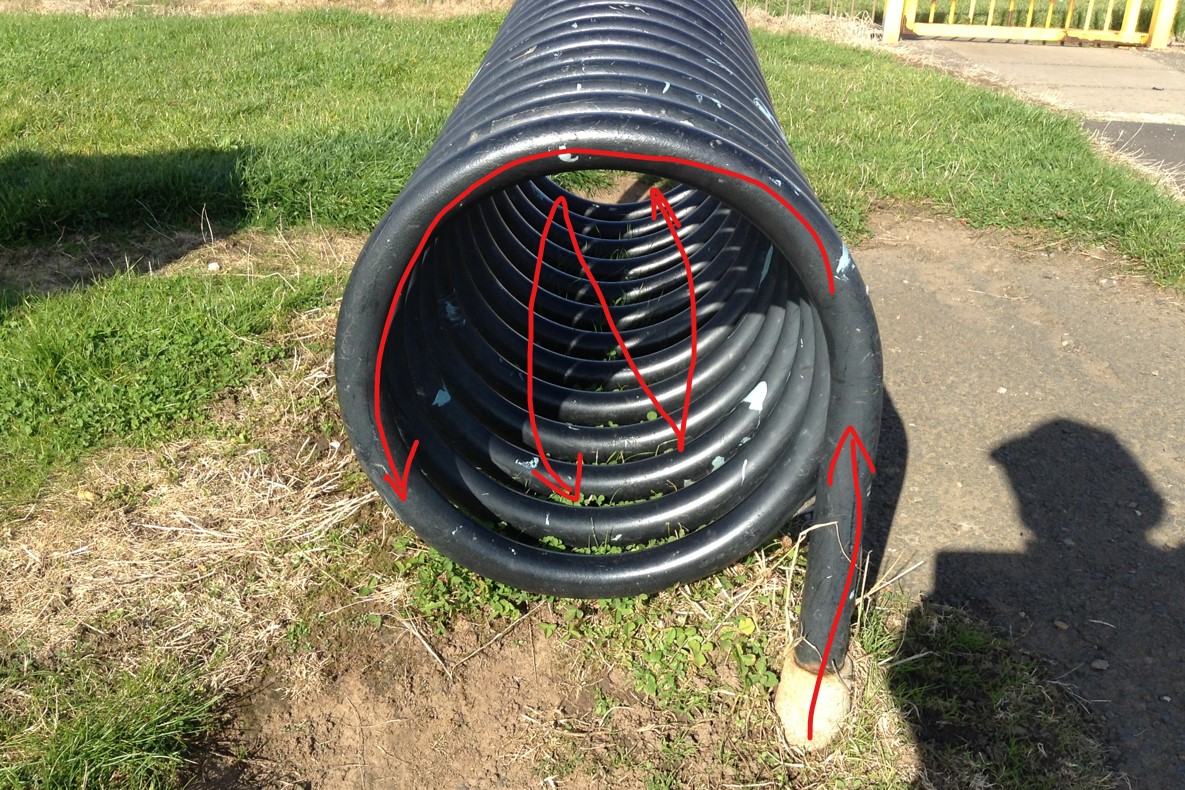
The current must be coming out at the other end meaning current flows clockwise. Adding arrows to an S points clockwise. This end is a South pole.

Saturday, 1 October 2022

Saltcoats Solar Time

 It was 11.27am BST.

The lovely sundial in Saltcoats was at roughly 10.15GMT so actually about 15 minutes out.
I loved the phrase that my watch tells me "legal time".
Local time is set by when the sun is highest in the sky being 12 noon. You can tell by when the shadow on a vertical stick is shortest. Legal time has 12 noon fixed as being when the sun is highest in the sky in Greenwich. This fixing was necessary to make the time the same everywhere when railways appeared, needing fixed timetabling. It takes 24 hours for the Earth to rotate through 360 degrees so that's 15 degrees an hour. We were 4.5 degrees west so that's 18 minutes behind legal time, which is about right allowing for the width of the shadow.