Saturday, 31 August 2019

Magnetic north and true north

True north is the direction you'd have to walk in to get directly to the North Pole. You'd be walking along a line of longitude. When a compass points north, it is being attracted to the south magnetic pole in the core of the Earth. As I understand it, this is due to the movement of iron in the core so that magnetic pole moves around. Most of the time, magnetic north and true north do not line up. Newspapers today were full of the excitement that they will line up along the Greenwich Meridian in the next couple of weeks - the first time this has happened since the Meridian was named https://www.theguardian.com/science/2019/aug/30/compasses-to-point-true-north-for-first-time-in-360-years Since Wigton is not on the Greenwich Meridian, it won't quite be happening here yet.

Friday, 30 August 2019

High pressure and tide height

It was a spring tide so the water level was going to be low anyway but we were warned to be back to the harbour on time for the boat because high pressure was making the tide even lower. I suppose that it makes sense that if the air pressure is high it will push down more on the sea and lower the level. https://noc.ac.uk/files/documents/business/Tides-and-Meteorological-Effects.pdf has a summary. The effects are spread out over an area but it is true.

Thursday, 29 August 2019

Moments and light fitting at Mosedale Quaker Meeting House


Mosedale Quaker Meeting House runs as a coffee shop during the summer months. I liked the impressive light fittings in this very old building. The first picture shows a light hanging on the end of a cantilevered bit of rail. It is causing an anti-clockwise moment around the first support. For equilibrium, there needs to be an equal and opposite moment. The second light could provide this but it is further from the support than the first light. Assuming that the lights have equal weight, then the clockwise moment will be bigger. But there is a second support. The reaction force at this support provides the extra anti-clockwise moment needed for equilibrium.

Sunday, 25 August 2019

Ennerdale River Research: a fair test
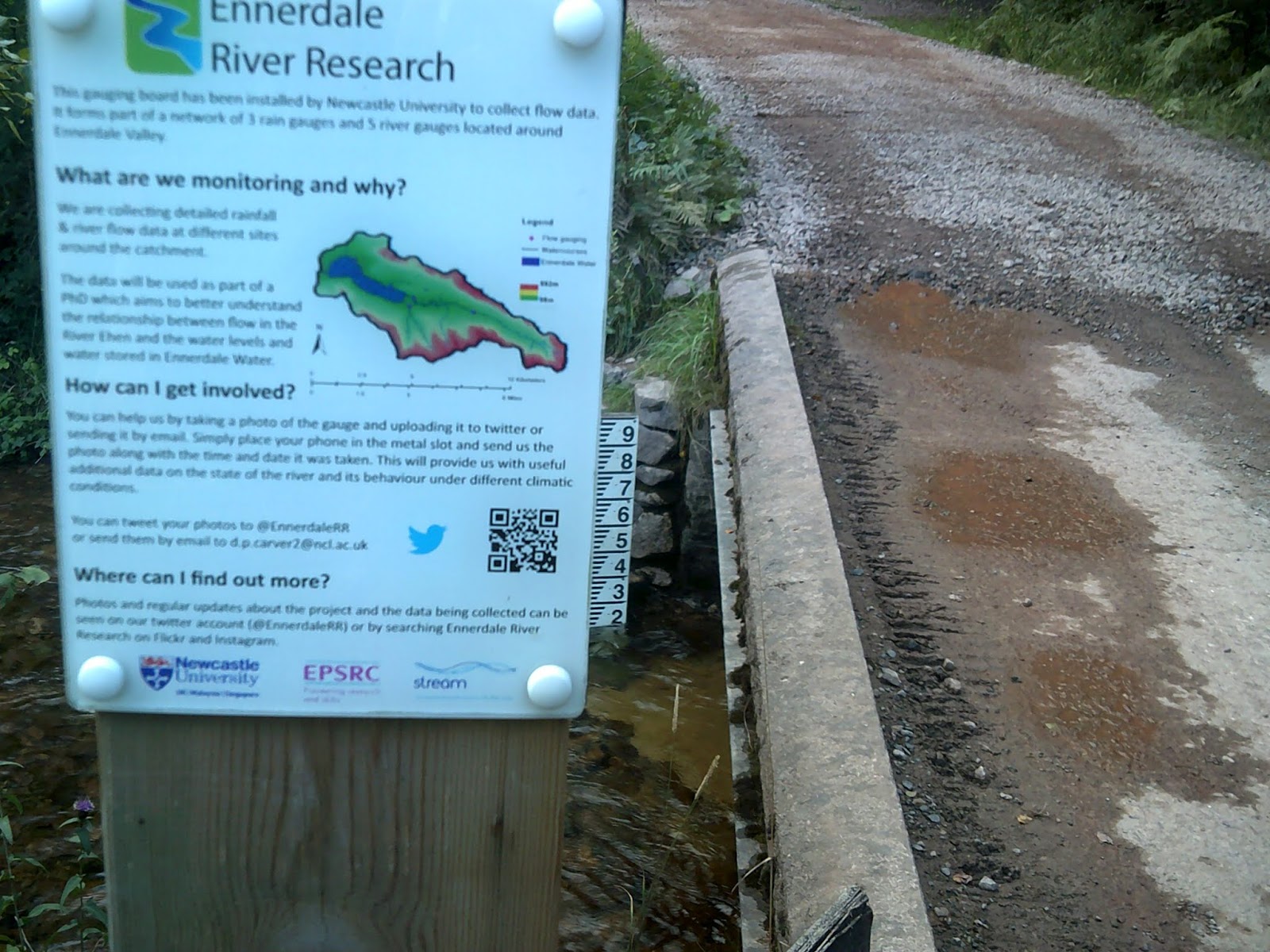

One of the key things about scientific data is that all extra variables should be controlled. I found this on the track from Bowness Knott past Ennerdale Water. It is clearly important that the smart phone photographs give the same angle so the readings on the water level meter can be compared. Sadly my camera wouldn't fit the slot so my data is inadmissible.

Friday, 23 August 2019

Earthing an electric fence

I've never really thought about electric fences before and hadn't realised that they needed an Earth connection until I saw this  on St Agnes. The battery has two terminals, + and -. The + terminal is connected to the wire giving it a potential. When the animal touches the wire, it's feet are at 0 Volts so current will flow through it from the high potential to the 0 Volt potential. But for a suitable current to flow from the battery there needs to be a complete circuit. Current needs to flow back from the Earth to the battery, hence the Earth lead is connected to the - terminal on the battery. It turns out that the wetter the ground the better because the wet ground conducts, having a lower resistivity. https://www.rappa.co.uk/advice-centre/28-earthing-guide-for-electric-fencing     https://kencove.com/fence/97_How+an+Electric+Fence+Works_resource.php

Thursday, 22 August 2019

Glassy sea

Sailing from St Marys to St Agnes the sea surface was especially reflective. I've always thought of this as a "glassy sea" from the Biblical quotation. I was thinking about why it is so reflective. One possible answer is the the foreground. The motion of the boat through the waves mixes air into the water creating the white water. This does not offer specular reflection. There are too many surfaces in the bubbles which reflect light in all directions - a scattering effect giving the white colour. This is diffuse reflection. Any disturbance of the water by wind will give this and remove the specular "glassy" effect.

Wednesday, 21 August 2019

Sand washing away from under my feet

I stood in the sea and let the waves wash over my feet. As the wave went out I could feel the sand being pulled away from under my feet.
It didn't seem to be washed away anywhere else. I can't find a clear description of this online. I was wondering whether it is linked to dilatancy (see https://www.scientificamerican.com/article/make-water-disappear-with-the-wet-sand-effect/) This is the effect whereby sand around your feet appears drier than the rest of the sand because the pressure causes the sand grains to spread apart. The water then flows into these wider spaces. If the tide puts even more water in, might that make the sand flow more easily by making it more like a liquid?