Thursday, 7 July 2016

3 quarts for Muster Mark??

 I found this quart pot in a pub in Broadway in the Cotswolds. A quart is 2 pints or one quarter of a gallon. Murray Gell-Mann had an idea that James Joyce's "Three quarks for Muster Mark" quote might have been him ordering 3 quarts of beer. Or at least that was his excuse for continuing to pronounce his particles "qwork". See the link http://www.finwake.com/1024chapter24/1024finn24.htm

Wednesday, 6 July 2016

Partial reflection

It was the annual Ogden Awards night at Lancaster University last night and we got our first view of the new department buildings. The lighting conditions gave us the perfect example of a type of partial reflection. You can see the inside of the building. It must be being lit by light from the outside which is going through the glass, hitting the room and reflecting back to us. Then light from the outside also reflects back off the outside of the glass showing us the world behind us.

Tuesday, 5 July 2016

Not Brian Cox on Not the Matterhorn

To celebrate the new BBC series with Brian Cox the author of this blog struck a pose like that adopted by Brian in previous series, atop a mountain whilst the drone camera circles him. I chose the rock on the top of Grey Friar that resembles the Matterhorn. You can catch the real Brian here for the next few weeks http://www.bbc.co.uk/iplayer/episode/b07k7m4z/forces-of-nature-with-brian-cox-1-the-universe-in-a-snowflake


Monday, 4 July 2016

Warped Passages by Lisa Randall

I've just finished this wonderful book. It explains how the Universe probably exists in more than the 4 dimensions that we can easily sense. Some theories work best in an 11-dimensional universe. Lisa Randall's own theory is roughly of a 4-dimensional brane that is somehow surrounded by a fifth dimension in which gravity can operate. She develops the history if the ideas from Newton onwards. The use of stories and allegories helps. Or you could catch some of the Youtube programmes she has done: https://www.youtube.com/watch?v=TuL7gSMzLlU or https://www.youtube.com/watch?v=SojWeJtYSr0&spfreload=5

Sunday, 3 July 2016

Gauge invariance at Loch Muick


The bizarre tracks heading into the loch must have been for launching boats. They are right next to the boat house. The width of railway lines has always been referred to as the GAUGE. I had always wondered why this word had come into particle physics. The idea seems to be that on railways, the change of scale doesn't affect the product - you get the same thing, a train down a track. In field theory, it seems to be that if you change certain things, you retain the same basics. There is a symmetry across different "gauges". Presumably a different gauge of track would still put a boat in the loch. I'm just developing my understanding of this area.

Saturday, 2 July 2016

Mental arithmetic in the hills part 2: km/h on Broad Cairn


We climbed Broad Cairn on Deeside and used the Queen's Land Rover track. I've been trying to learn km. I was successful in transferring from feet to metres a decade ago. But I still think of distances in miles. I know that we tend to average 1 mph over high mountains. But we had the chance to come back down vehicular access to a high hunting lodge. 4 km of track. Could we do it in 1 hour? So that is is 1 km in 15 minutes. 60 metres per minute would be 600m + 300m = 900m in 15 minutes. So roughly 1 metre per second. That's one big stride every second. Well, we did it. So I now have more of an idea about distances and speeds.

Friday, 1 July 2016

Flame probe for uniform field


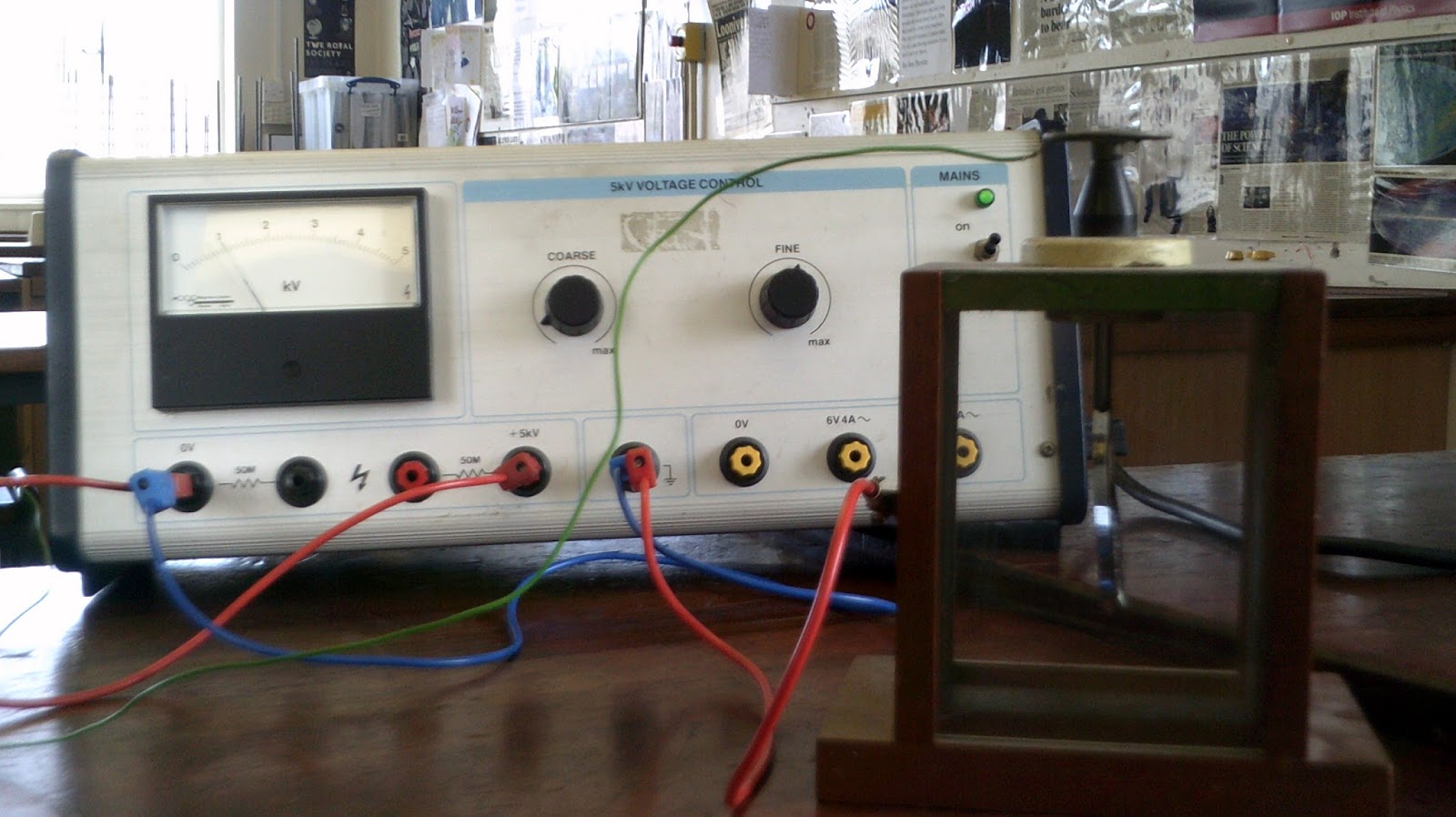
I used this equipment to measure the potential in the uniform field between two parallel plates. I had a potential difference of 600V. I measured the angles of the gold leaf at 0 mm from the negative plate and then when it was touching the positive plate. I was then able to calibrate a scale to turn other angle measurements into voltages. I made this diagram to explain how it works, to amplify the explanation I gave in my previous post:
The closer the probe tip is to the positive plate, the more electrons are attracted from the gold leaf and the bigger the angle. Work is done against an attractive force to pull the electrons up so the angle represents potential energy. The graph looked like A below:
If we pulled the plates apart, the potential difference would be the same but the field would be weaker. So field strength is represented by the gradient of this graph. However, we went from - to + whereas the direction of an electric field is from + to -. To sort this out, we insert a - sign:
Field strength = - potential gradient