Sunday, 30 September 2018
Total internal reflection at Blackpool Illuminations
This fountain at the Theatre d'Amour was interesting. As the water fires upwards, it also sprays out sideways. It is lit from below at the single point from which the water diverges. Yet the light follows the water as the water curves. This is particularly evident on the left hand side of the spray. Light goes in a straight line and yet it can curve by zig-zagging due to total internal reflection.
Saturday, 29 September 2018
Wave equation from Blackpool Tower
I was looking down from Blackpool Tower and noticed that the wavelength seemed to be increasing as the waves reached the shore. But the opposite should be true. Since velocity = frequency x wavelength and waves slow down in shallow water, the wavelength should decrease if the frequency remains the same. Maybe the wavelengths really are bigger further out but perspective makes them look smaller by comparison. A quick search of the Internet came up with some interesting sources to look at further.
Friday, 28 September 2018
Concave mirror on Blackpool Pier
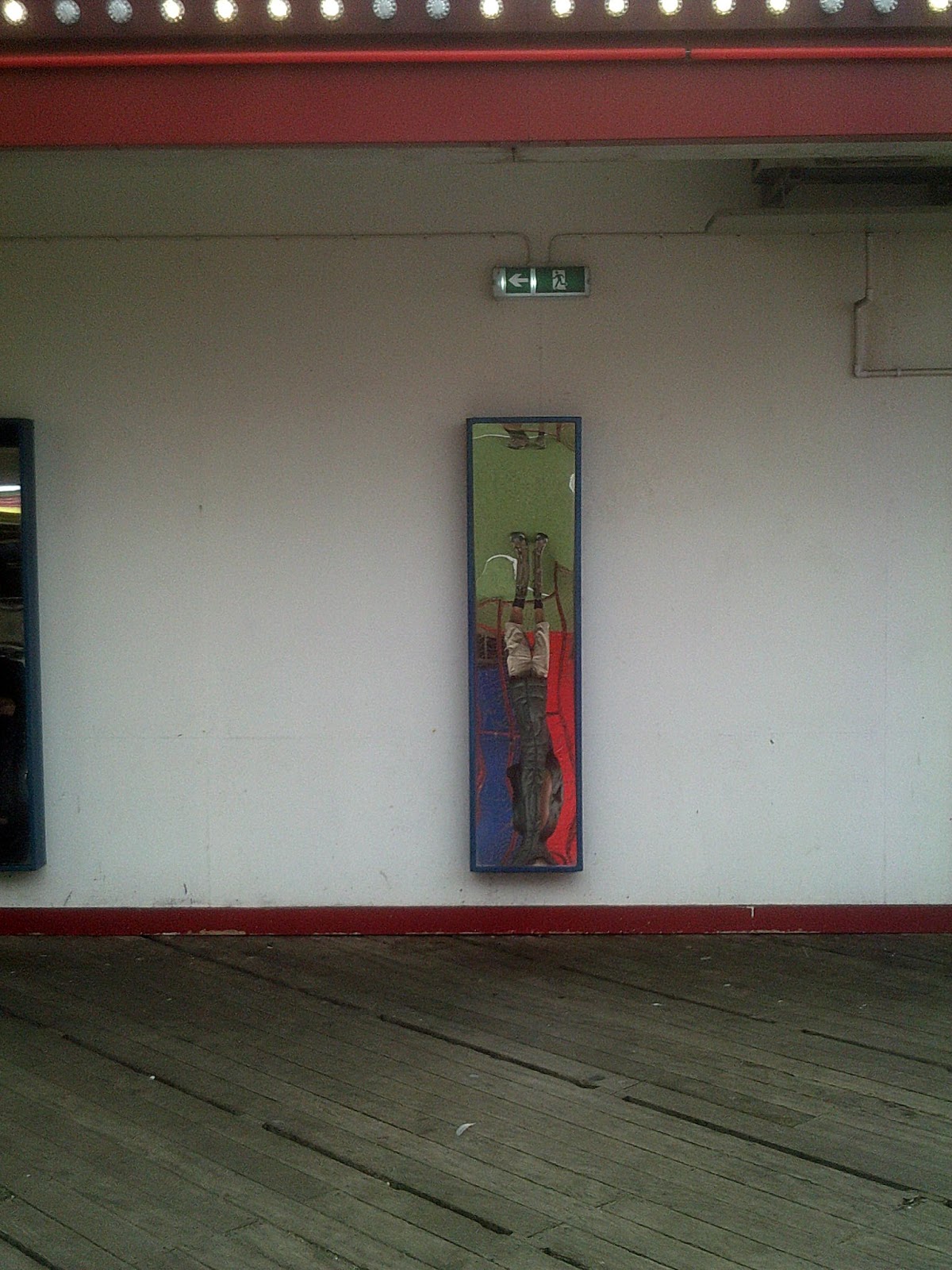
I loved the mirrors on Central Pier in Blackpool. This was the concave one. When you are reflected, the top of the mirror sends the rays from your head downwards. The bottom of the mirror sends the rays from your feet upwards. If you stand a long way off, the two rays cross over and the rays from your feet end up on top. You look upside down.
Closer in, the rays have not had a chance to cross over so you are still the right way up. What is more, given that your brain thinks the image is as far behind the mirror as you are in front, it computes where the rays that are converging must have been behind the mirror, working out that they must have been further apart back there. So your brain gives you an image that is bigger than the original.
Thursday, 27 September 2018
A dislocating gate
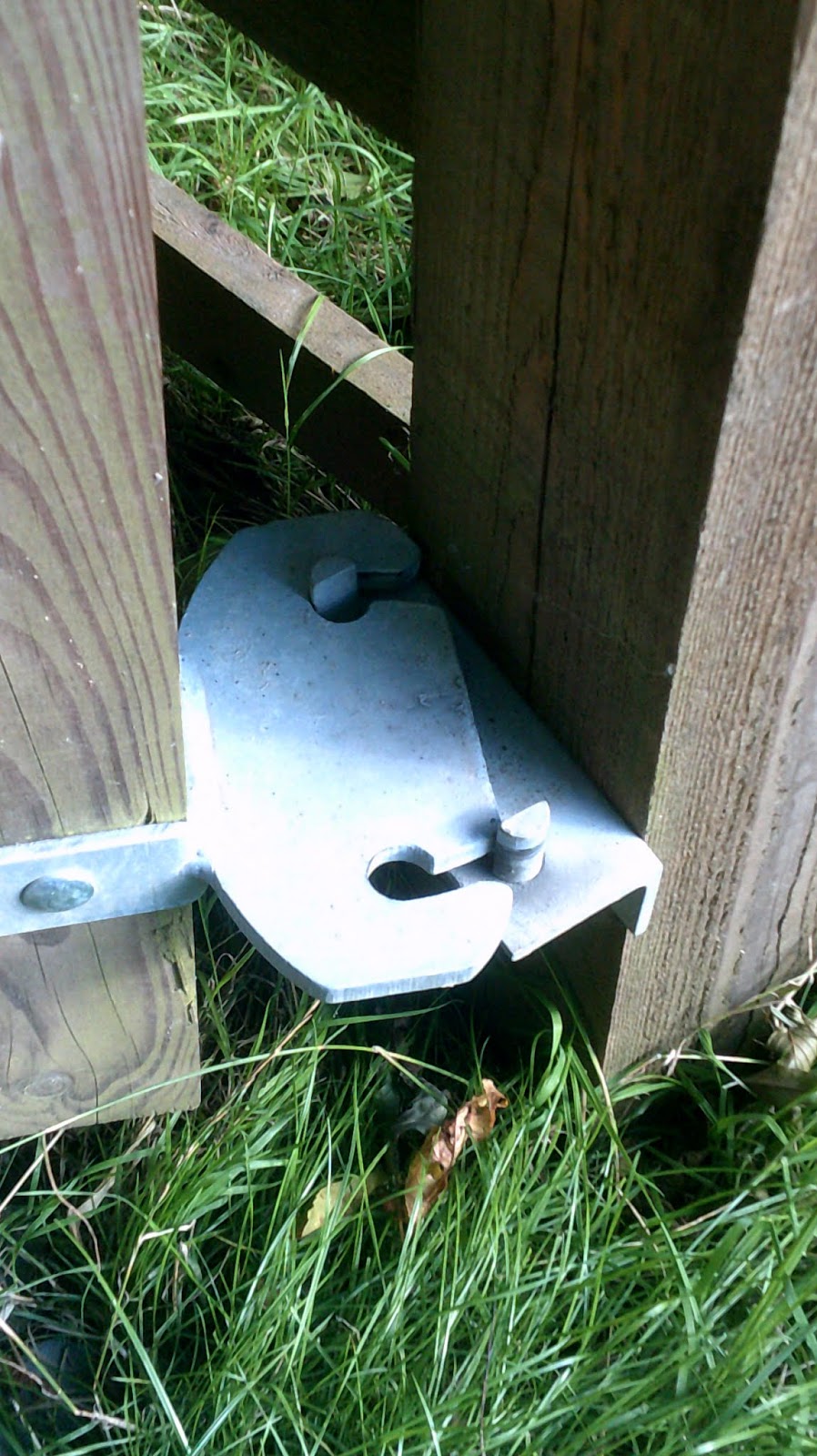
The gate in the top pictures seems like an odd one. It is only actually attached to the gate by the top hinge. The bottom is merely leaning on the gate. I've drawn a force diagram at the bottom. Only the top hinge is needed to produce a normal reaction force N to hold up the gate. The bottom hinge pushes on the gate with a force R to create a moment that is equal and opposite to the moment created by the weight of the gate. The contraption at the bottom is there to keep the gate in place as it turns.
Tuesday, 25 September 2018
Angular width of a rainbow
If you look at this rainbow, its angular width is about 1 degree, the angle subtended by my little finger. Also note that it is about 90 degrees to the horizon. This happens later on in the day when the Sun is nearing the horizon. A rainbow is a full circle in theory. Its centre is diagonally opposite to the Sun, following a line down from the Sun through you. The centre is thus called the anti-solar point. The lower the Sun, the closer the anti-solar point is to the horizon and the more of the rainbow is above the horizon. I suppose that in theory half of a rainbow should be above the horizon at sunset over the sea and the angle to the horizon at that point would be exactly 90 degrees.
Sunday, 23 September 2018
Gneiss at Crocodile Rock, Rosemarkie
I had always associated gneiss with Lewis so I was a bit confused to find it on the east coast at Rosemarkie. Lewisian gneiss is the oldest rock in the UK. The rocks are called Pre-Cambrian because they predate the first named geological era. That means they are over half a billion years old. Gneiss is a metamorphic rock that has recrystalised due to heat and pressure. I think the original rock here was granite, which would account for the pink colour. And how did it end up here? Well, it turns out that we were on a continuation of the Great Glen Fault - plenty of heat and pressure as the north of Scotland scraped against the Highlands but also the possibility of bringing deeper rocks to the surface. And the rock on the beach really does look like a crocodile!
Saturday, 22 September 2018
A new type of filament bulb
This is an LED filament bulb. That's an oddity. A filament is normally a wire that gets hot and glows. The wire is said to be incandescent. Here, LEDs are produced in series along a stem to look like a filament. This is how it gets to be only 8Watts. see https://en.wikipedia.org/wiki/LED_filament
Subscribe to:
Posts (Atom)